
What changed
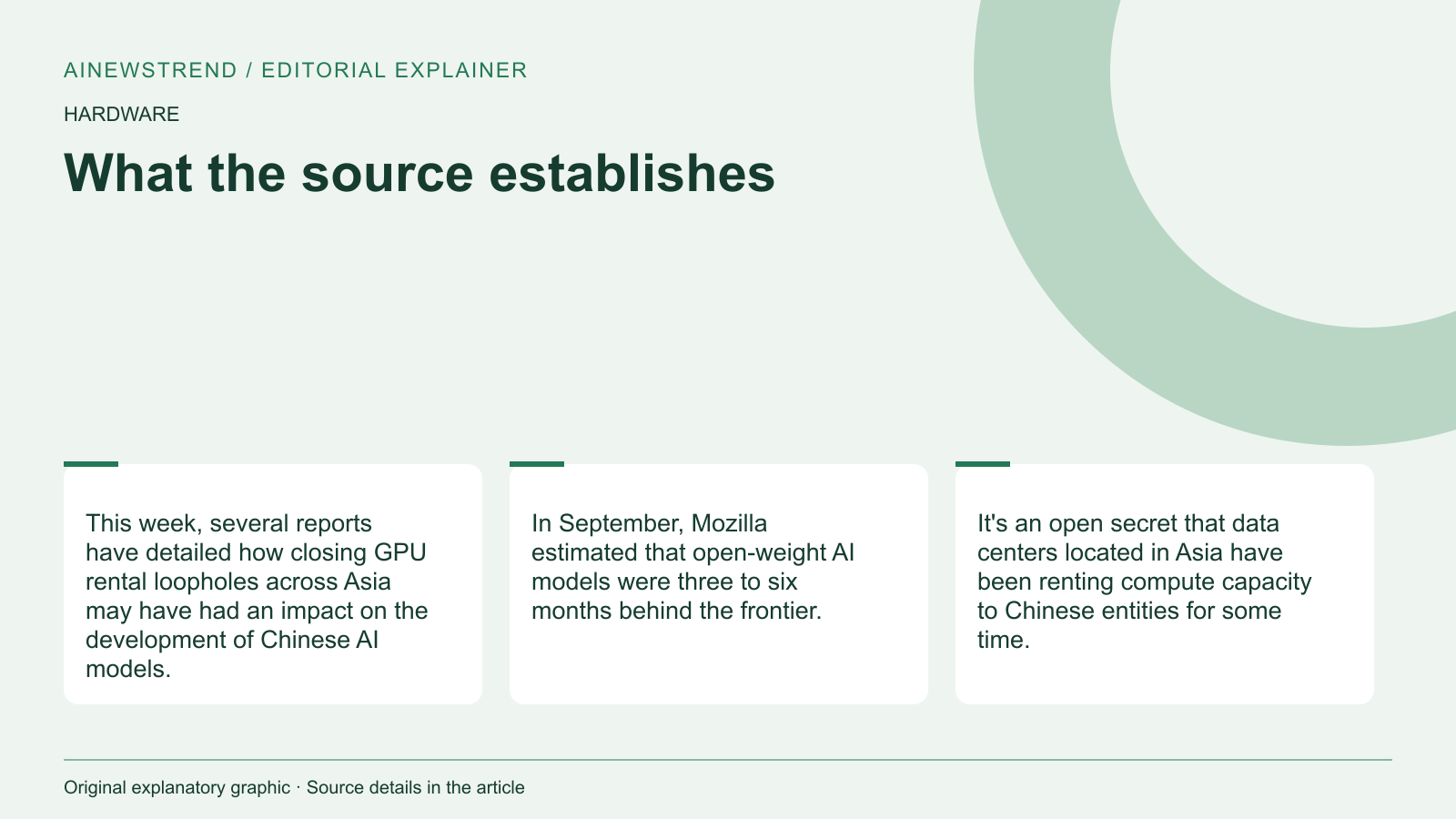
This week, reports indicate that Chinese AI models, many of which are open-weight, may fall behind Western counterparts by up to nine months due to export controls and reduced access to advanced AI accelerators. Zhipu AI, the developer of the GLM series, has allegedly pushed back its release calendar as a result of these constraints. The U.S. Department of Commerce has tightened rules on data centers lending compute capacity to Chinese entities, impacting the training of AI models in the region.
What this means in practice
The restrictions on GPU rental and access to Nvidia's AI accelerators are stifling the development of AI in China. While some companies like DeepSeek are attempting to shift to Huawei's Ascend AI chips and open-source CANN, the broader industry faces challenges from tightened security against model distillation. This practice, which has been central to China's AI progress, is now under stricter scrutiny, further complicating model development. The gap between Chinese and Western models is also evident in benchmark scores, with Anthropic's Claude Fable 5.2 leading at 65 points compared to China's Kimi K3.1 Pro at 47.
Limitations and availability
The current situation highlights the difficulty Chinese labs face in maintaining competitiveness amid export controls and limited access to high-performance hardware. While China still holds the top spot in the open-weight arena, Western labs are releasing more performant models. The availability of localizable Chinese models is being challenged by newer Western models like Inkling 2 Mini. Additionally, the development of advanced accelerators like Huawei's Ascend 950DT and Nvidia's Rubin R200 underscores the hardware disparity, with the latter offering significantly higher compute and memory capacity.