
What changed
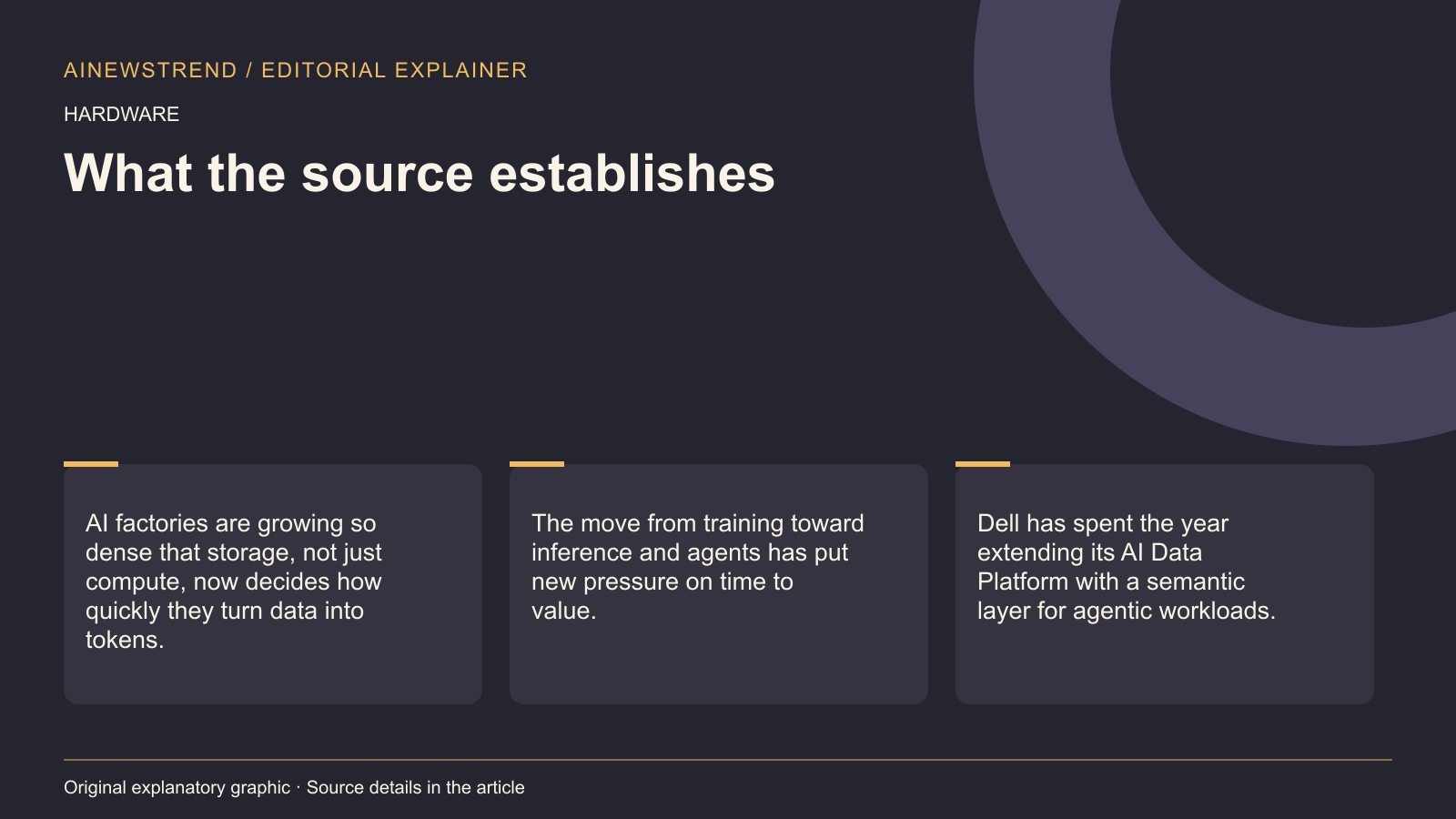
Dell Technologies Inc. has announced a shift in its PowerEdge servers, turning them into flexible, software-defined storage nodes that can adapt to changing AI workloads. This move comes as AI factories increasingly prioritize storage efficiency over compute power, according to George Papadopoulos, senior vice president of product and engineering at Dell.
What this means in practice
Dell’s AI Data Platform now includes a semantic layer for agentic workloads, expanding beyond traditional compute and GPU capabilities. The company introduced Dell Exascale Storage, a licensed software solution that runs on PowerEdge servers, allowing customers to deploy multiple storage personas—file, block, object, or parallel file—depending on their needs. This flexibility enables customers to repurpose storage as workloads evolve, such as moving from file storage to object storage.
Dell also unveiled a 2U, 32-drive node with 100% liquid cooling, claiming it as the first direct liquid-cooled storage for rack-scale AI. This innovation addresses the cooling demands of dense AI systems, with Papadopoulos noting that customers are planning for fully liquid-cooled data centers.
The separation of storage software from hardware allows Dell to introduce new PowerEdge generations more quickly, providing neocloud operators with greater flexibility and avoiding data silos.
Limitations and availability
The supplied announcement does not specify exact pricing, licensing terms, or availability dates for the new storage nodes. Dell Exascale Storage is described as a licensed software solution, but the exact conditions of its deployment and compatibility with existing systems are not detailed. The 2U, 32-drive node with liquid cooling is presented as a new offering, but its availability and deployment timeline remain unspecified. The company emphasizes the flexibility of the solution but does not provide benchmarks or independent testing results to support performance claims.