
What changed
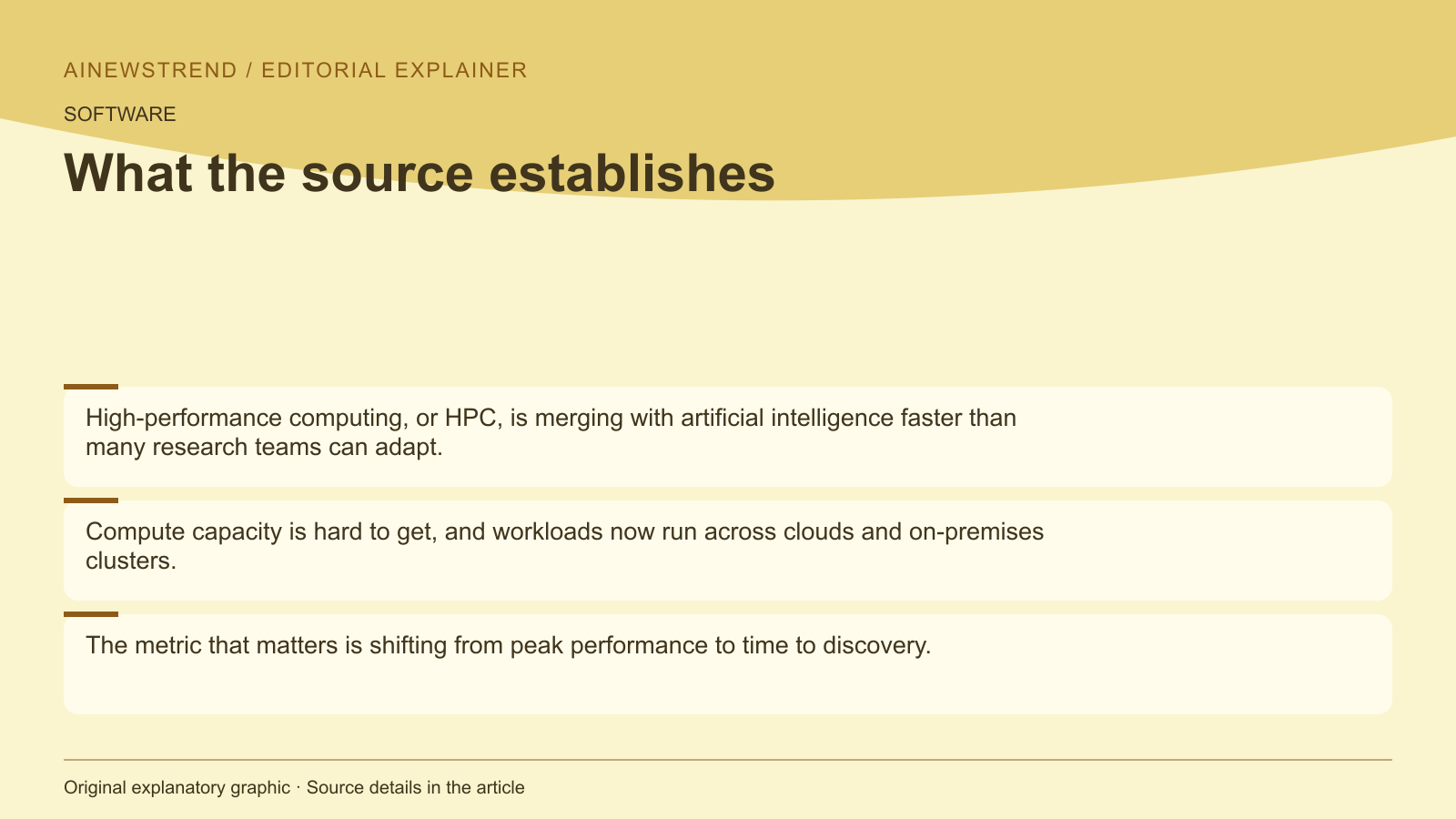
At SC26, Google Cloud announced its agentic HPC strategy, which integrates AI agents to simplify access to distributed computing resources. Annie Ma-Weaver, head of high-performance computing product at Google Cloud, explained that the shift is from measuring performance in flops to prioritizing time to discovery. AI agents now help scientists explore research literature, debug code, and generate hypotheses in minutes instead of weeks.
What this means in practice
Researchers and engineers are using AI agents to streamline workflows in simulation and weather forecasting. For example, in computer-aided engineering, AI is used to identify non-essential parameters before running simulations, reducing total simulation time. The National Oceanic and Atmospheric Administration’s forecasting platform now runs on Google Cloud, and the National Hurricane Center used Google’s WeatherNext model to predict Hurricane Melissa’s path and intensity in October 2025.
Limitations and availability
The integration of AI agents into HPC workflows is still in development, with Google Cloud emphasizing that AI is not perfect and can produce 'AI slop.' The company’s agentic HPC strategy is built on three pillars: purpose-built hardware, open-source orchestration tools like Slurm and Kubernetes, and collaborative AI agents. The approach was outlined in Google Cloud’s SC26 announcements, but the full availability and performance details are not yet specified in the snapshot.