
What changed
Hugging Face announced the release of KVAE-3.0, a new set of tokenizers for audio, image, and video domains. These models are trained using advanced latent alignment techniques, which aim to improve the quality of generated outputs. The release includes three variants: KVAE-Audio-Stereo, KVAE-2D-3.0, and KVAE-3D-3.0.
What this means in practice
KVAE-Audio-Stereo is a 48 kHz VAE for general stereo audio at a 50 Hz latent rate, exceeding 70% win-rate on generations quality comparison against leading open-source VAEs: Stable Audio 3 and LTX-2.5. KVAE-2D-3.0 matches the latent size of FLUX.2-VAE, obtains higher PSNR and SSIM on reconstruction, and provides faster FID-convergence. KVAE-3D-3.0 compresses frames spatially by a factor of 32 and temporally by 4, outperforming MiniMax-H3 VAE over human preference tests.
Limitations and availability
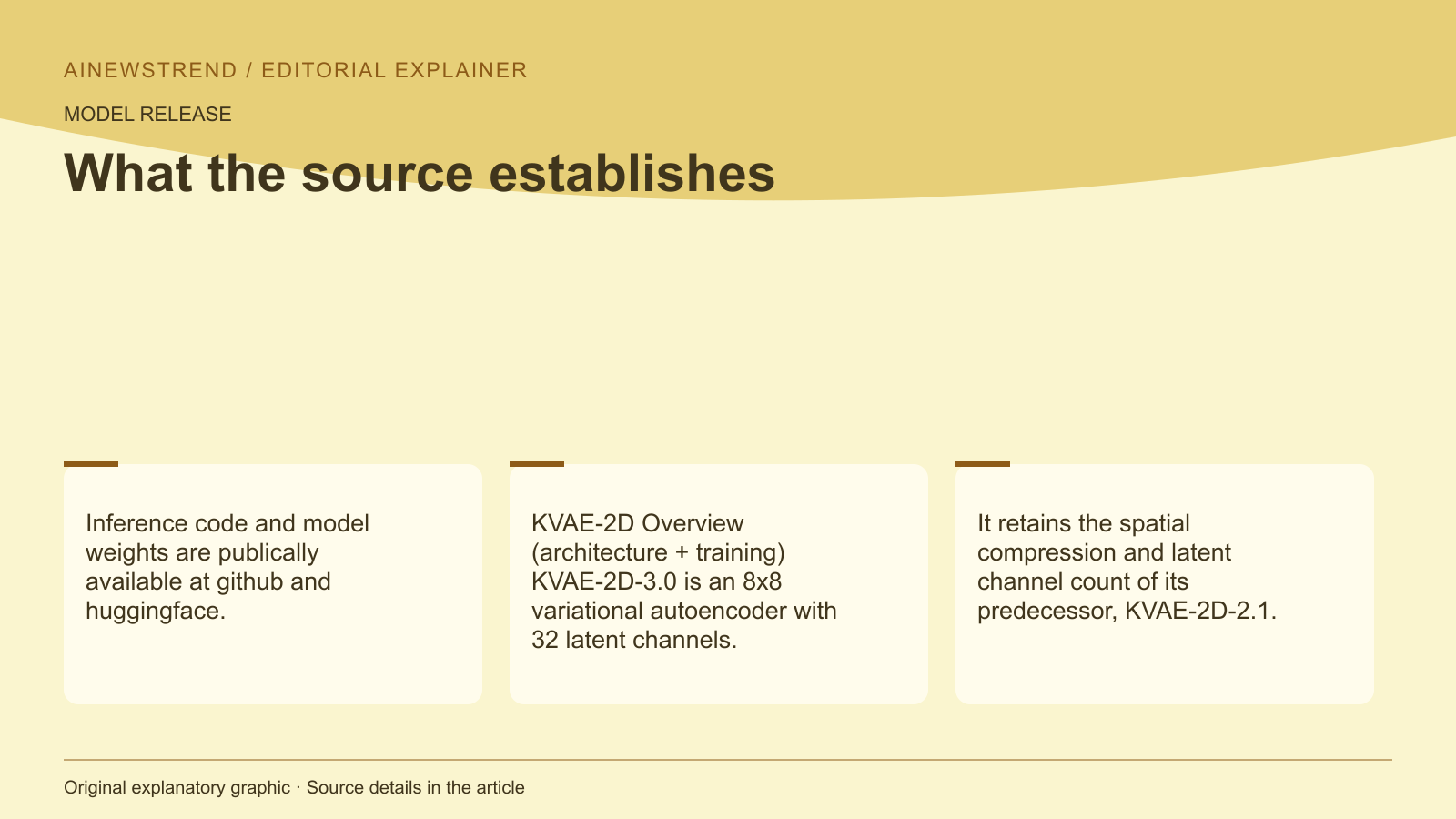
Inference code and model weights are publicly available on GitHub and Hugging Face. KVAE-2D-3.0 is an 8x8 variational autoencoder with 32 latent channels, using self-attention in both the encoder and decoder bottlenecks. The tokenizer used at inference comprises a 34.8M-parameter encoder and a 50.8M-parameter decoder, for a total of 85.6M parameters. The model is trained with an alignment probe based on the SiT-XL/2 diffusion transformer, with a focus on feature alignment and velocity prediction. The VAE and probe are trained from scratch and the probe is discarded after training. The decoder is finetuned with L1, LPIPS, and adversarial objectives on 512x512 crops of high-quality images. The video tokenizer, KVAE-3D-3.0, is a 4x32x32 variational autoencoder with 128 latent channels, achieving a compression ratio twice that of its predecessor. The model uses V-JEPA features for alignment and has a higher resolution input patch vector compared to MiniMax-H3. The models are available for use, but the exact performance may vary depending on the specific use case and data.