
What changed
Hugging Face has announced the release of ZONOS3-Mini, an open-source Text-To-Speech (TTS) model that enables real-time voice cloning and multilingual speech synthesis. The model combines a 15 Hz dual audio codec (ZAC-1), a hybrid Gated DeltaNet / Attention Latent MoE backbone with 100M active parameters (800M total), and mechanistic activation steering. It is designed for real-time on-device execution across browsers, phones, laptops, and servers.
What this means in practice
ZONOS3-Mini is trained on 112 NVIDIA H100 GPUs in just 2.5 days and uses a sparse Mixture-of-Experts (MoE) architecture to deliver high-quality speech synthesis and controllability at edge-friendly compute budgets. The model achieves <570 ms time-to-first-audio (TTFA) in-browser on a Pixel 9, <150 ms on an M3 MacBook Air, and 80 ms median TTFA (457× real-time peak throughput) on a single H100. Everything needed to test, build on, and deploy ZONOS3-Mini is open-sourced, including Apache 2.0 Model Weights, interactive Hugging Face Spaces, MIT-Licensed Runtimes, and open evaluation benchmarks.
Limitations and availability
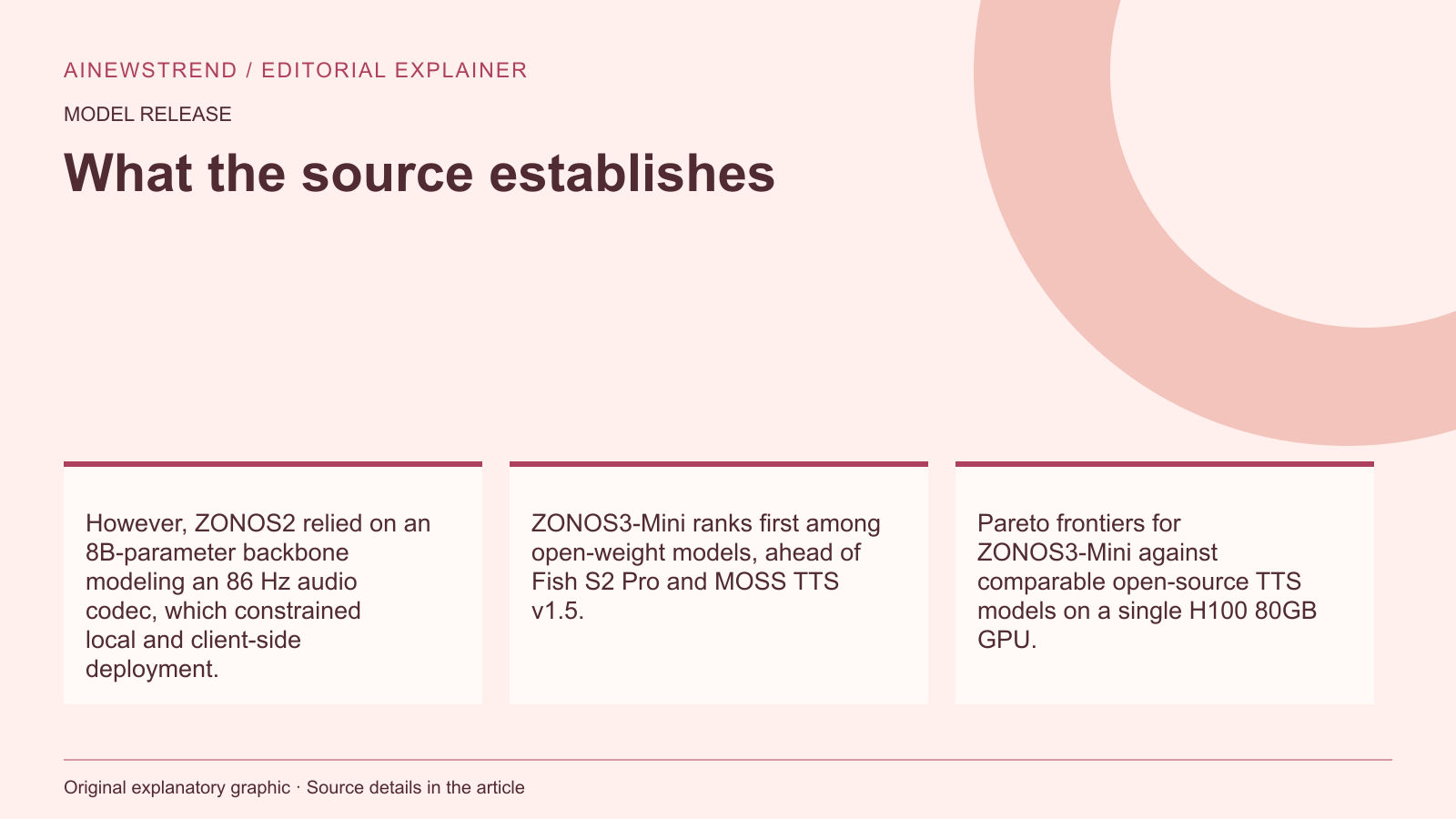
The model is available under the Apache 2.0 license and can be tested, built on, and deployed through Hugging Face Spaces, GitHub, and WebGPU. The ZTTS2-Eval benchmark provides expanded multilingual evaluation covering 35 clean and 20 in-the-wild language subsets. ZONOS3-Mini ranks first among open-weight models, ahead of Fish S2 Pro and MOSS TTS v1.5. The model is available for use across multiple platforms, including browsers, phones, laptops, and servers.