
What changed
NVIDIA announced the Rubin HPC GPU at SC26, part of the NVIDIA Vera Rubin platform. This GPU is designed to accelerate simulation and data processing for science, engineering, and analytics workflows. It features over 50,000 CUDA cores and seventh-generation NVLink interconnect technology to improve GPU-to-GPU connectivity. The GPU also includes sparse data acceleration capabilities to keep the CUDA cores fed with data.
What this means in practice
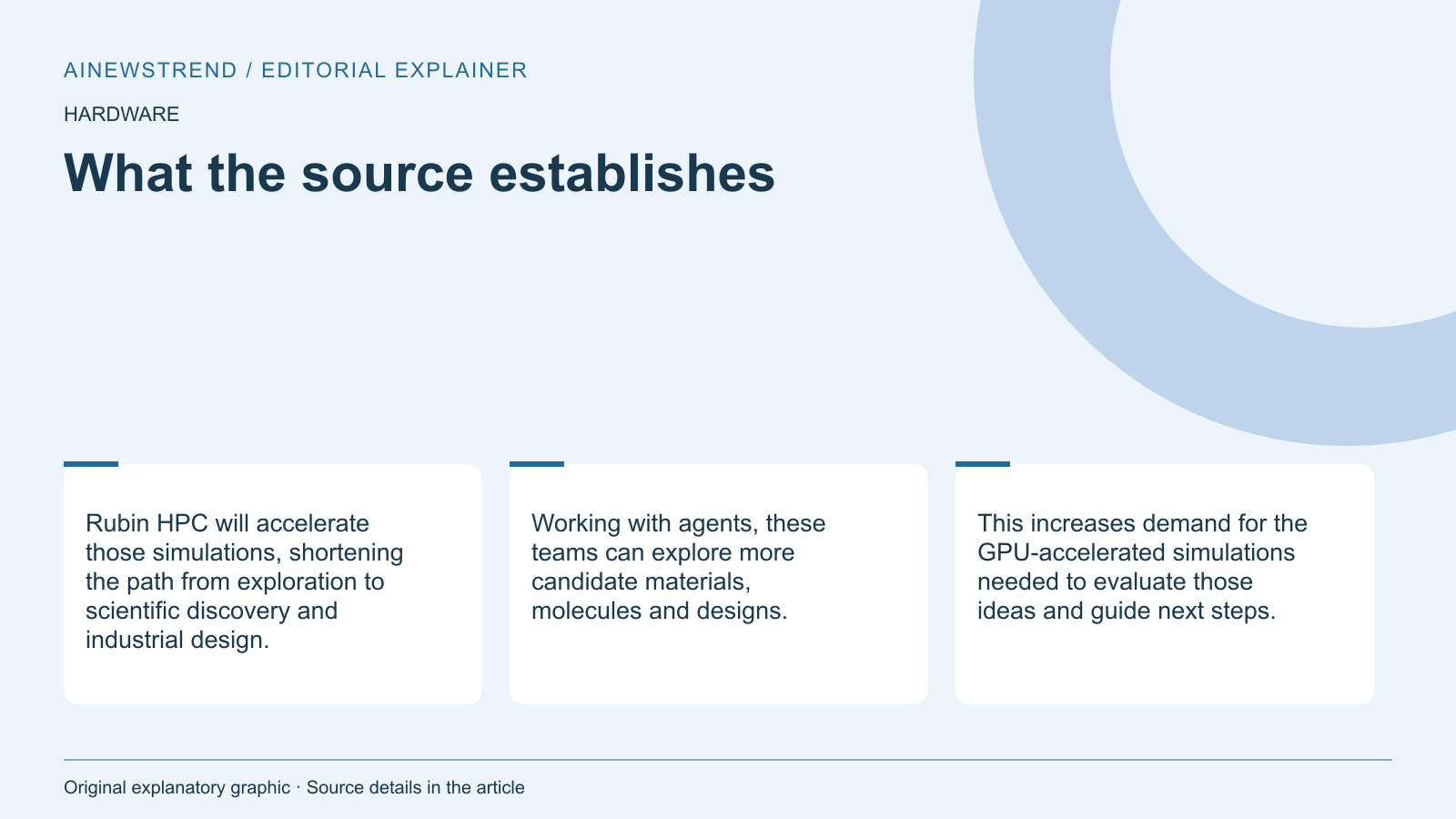
Scientists and engineers rely on simulations to understand complex systems before committing to experiments or physical prototypes. Rubin HPC is intended to speed up these simulations, allowing researchers to explore more candidate materials, molecules, and designs. The GPU's balanced design scales data movement and compute together, optimizing performance for scientific computing workloads such as sparse matrix operations, stencil computations, and sorting and reductions. NVIDIA CUDA-X libraries will provide optimized implementations of complex algorithms for agents to use, helping to accelerate scientific discovery.
Limitations and availability
Rubin HPC is expected to be available in 2028. The supplied announcement does not specify exact hardware requirements or licensing conditions for the GPU. The GPU's capabilities are intended to support a wide range of scientific and engineering applications, but the actual performance and availability will depend on NVIDIA's release schedule and the specific needs of the target audience.