
What changed
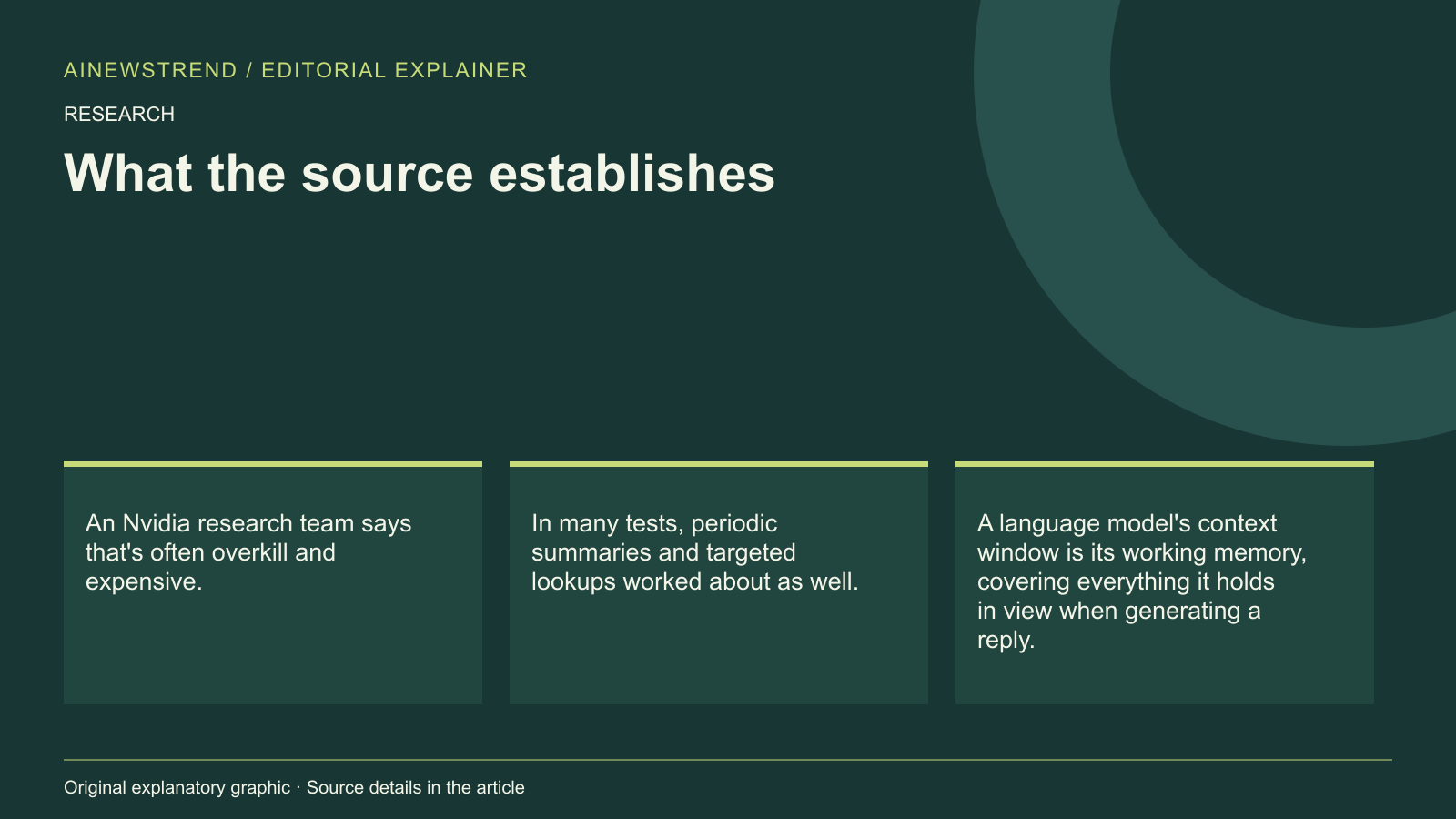
Nvidia researchers have claimed that large AI context windows, which allow language models to process extensive amounts of text at once, are a dead end. They argue that such models often require significant computational resources and may not provide substantial benefits in many practical scenarios.
What this means in practice
The research suggests that periodic summaries and targeted lookups can perform as well as processing entire novels at once. This implies that for many applications, smaller context windows may be sufficient, reducing the need for large-scale processing. The study highlights that the context window of a language model is its working memory, covering everything it holds in view when generating a reply. Over the past few years, this window has grown rapidly, with GPT-4 initially handling 8,190 tokens and newer models like GPT 5.6 Sol managing around one million tokens, enough for Tolstoy's 'War and Peace.'
Limitations and availability
The supplied announcement does not specify the exact methodology or benchmarks used in the research. It also does not mention the availability of the findings or any specific models that were tested. The study appears to be part of a broader discussion on the efficiency of AI models, with the research team from Nvidia suggesting that the current trend of expanding context windows may not be the most effective path forward.