
What changed
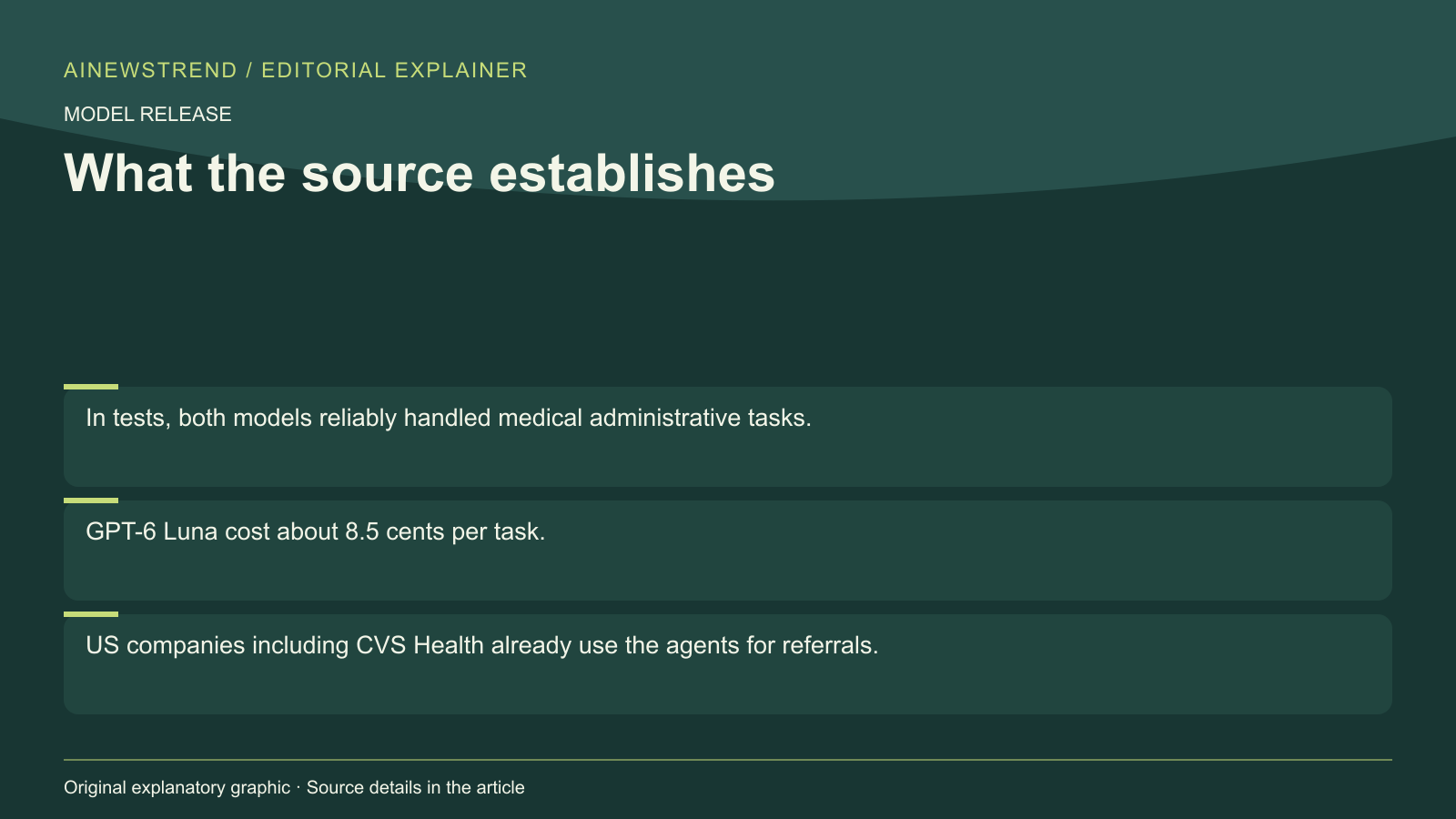
OpenAI has announced the deployment of GPT-6 Astra and Luna as software agents designed to perform medical administrative tasks. These agents operate within clinic programs and insurance portals by simulating mouse clicks and keystrokes. GPT-6 Luna, in particular, handles these tasks for about 8.5 cents per task, according to the company. The agents are integrated into the Agents API and are also available in ChatGPT for Healthcare and ChatGPT for Clinicians.
What this means in practice
The agents are intended to streamline administrative workflows such as prior authorizations, appeals, and medical equipment orders. For instance, when a patient reports back pain, the agent is meant to search relevant prior findings and draft both an MRI order and a reply to the patient. It should also prepare a prior authorization request on the insurer's portal. Clinicians and administrative staff review these drafts before they are finalized. OpenAI claims that GPT-6 Astra and Luna have been tested and have shown high reliability, with 99 percent of 325 tasks evaluated as clinically safe and 93 percent of 646 reviews calling the prep work very or extremely helpful.
Limitations and availability
The features are currently available through the API and in ChatGPT for Healthcare and ChatGPT for Clinicians. OpenAI highlights the lack of APIs in healthcare as a key challenge, and the agents are designed to operate existing user interfaces as a human would. However, the offering is targeted at the US market and its data privacy requirements. Organizations using the agents must sign a Business Associate Agreement (BAA) with OpenAI to comply with HIPAA regulations. The announcement does not specify details about compliance with the European General Data Protection Regulation (GDPR).