
What changed
On November 18, 2026, OpenAI announced that its models have significantly improved chip design efficiency, particularly in the development of its custom inference chip, Jalapeño, and third-party hardware from AMD. The models were used to optimize compute blocks, leading to reductions in standard-cell area and latency. These improvements were silicon-proven during Jalapeño’s silicon bring-up. OpenAI also reported up to 14% improvements on AMD’s flagship GPU IP, with some changes already integrated into AMD’s production design files.
What this means in practice
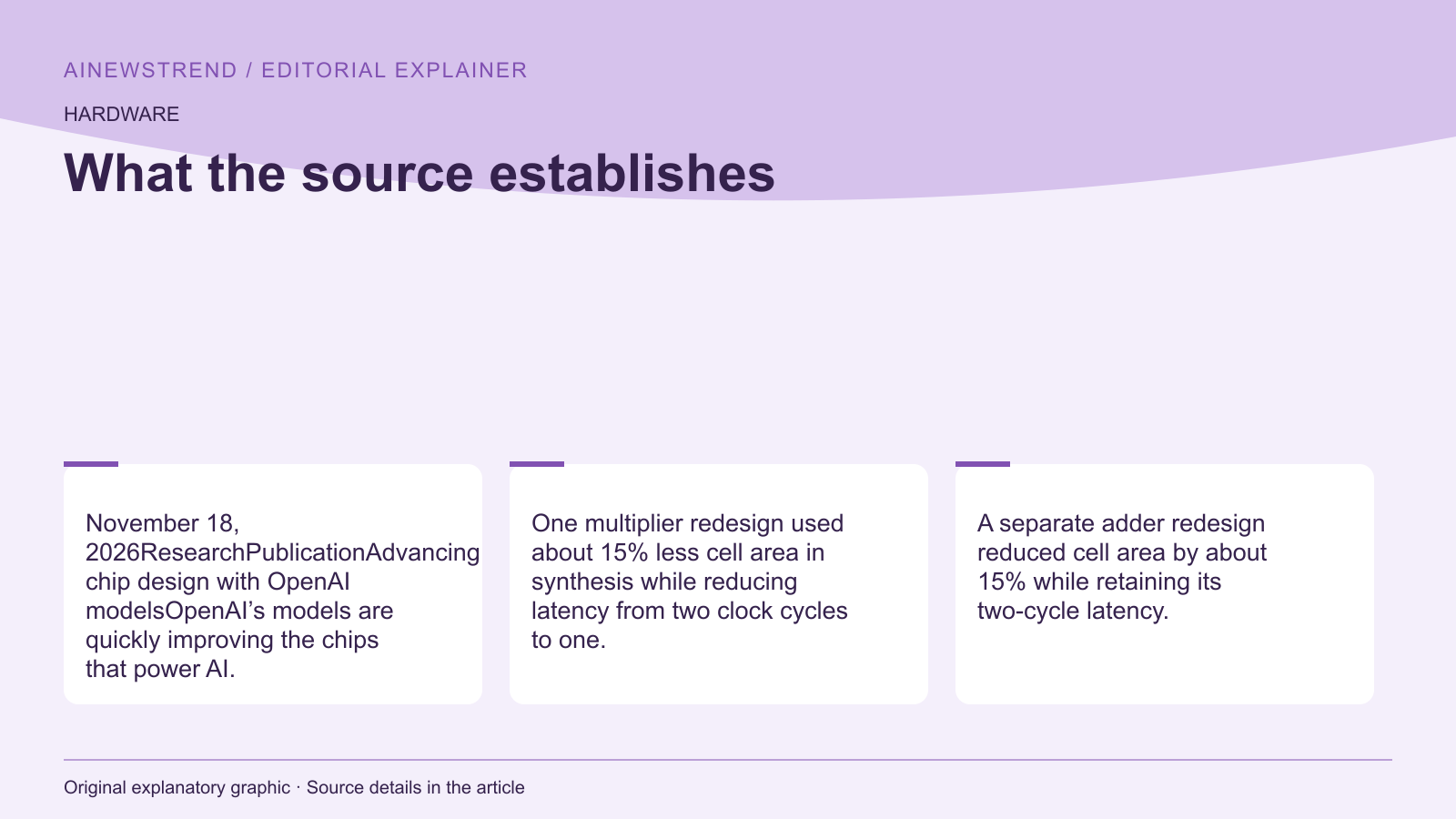
OpenAI’s models are being used to enhance the performance and efficiency of both custom and third-party chips. For Jalapeño, the vector unit saw a 13% reduction in standard-cell area, while the matrix unit saw a 10% reduction. These optimizations were achieved by redesigning components such as floating-point adders, multipliers, and dot-product circuits. On AMD’s hardware, the models identified further improvements by rewriting SystemVerilog RTL code, achieving results equivalent to a year of progress in under five months. AMD has already incorporated some of these changes into its production design files for future versions.
Limitations and availability
The supplied announcement does not specify the exact token budgets or model versions used in the RISC-V core optimizations. However, it does mention that GPT-6.2 Astra achieved the highest average score on both PicoRV32 and Ibex cores. OpenAI is also collaborating with Synopsys to train a new model, GPT-Synopsys, to use EDA tools as expert chip designers would. This collaboration aims to ground model development in trusted evaluators and broaden the design challenges addressed.