
What changed
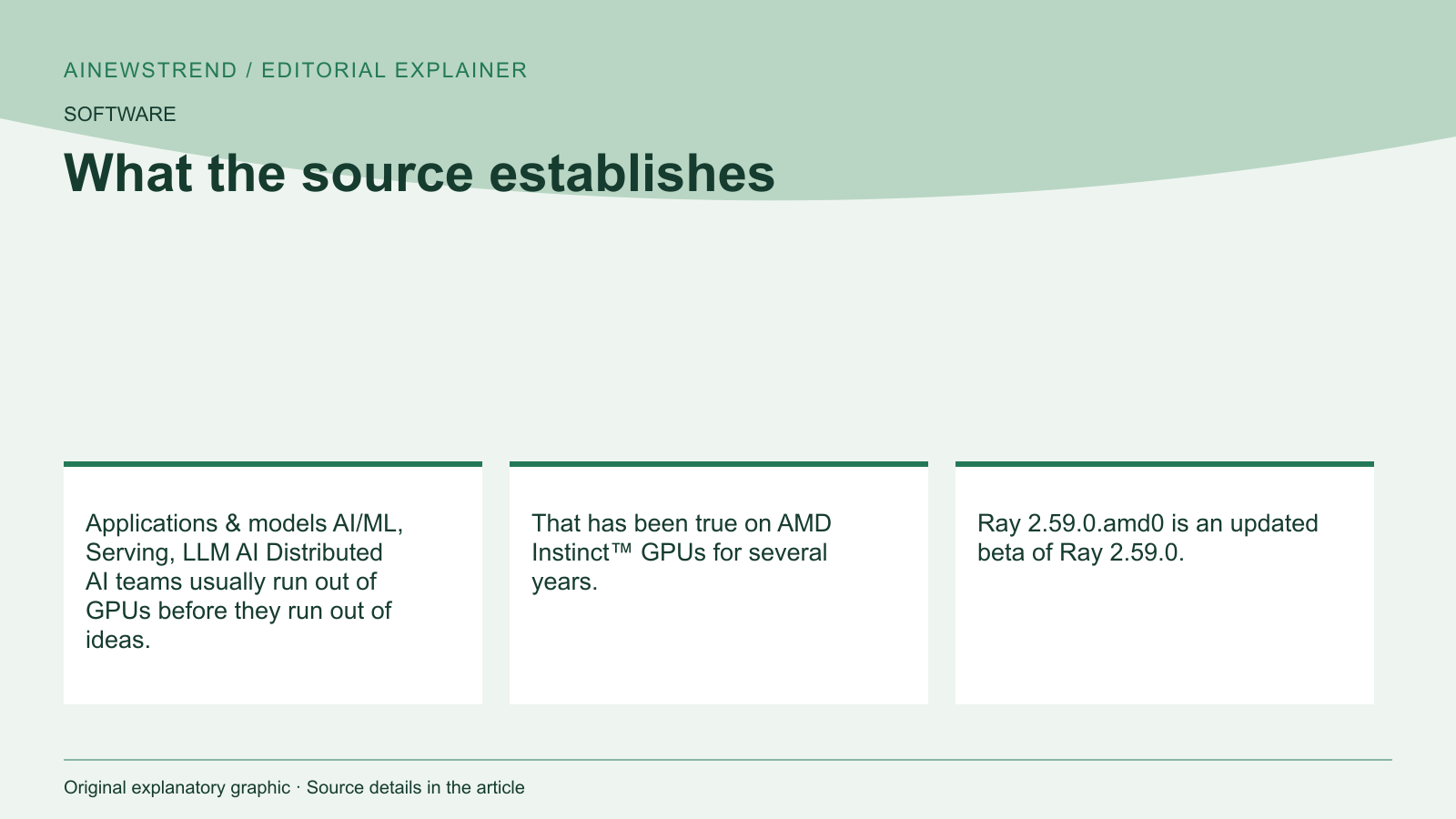
AMD announced ROCm 10.1.0, which includes support for Ray 2.59.0.amd0. This update enables scalable AI workflows on AMD Instinct GPUs, with existing Ray code expected to run unchanged. The new version supports vLLM 0.29, PyTorch 2.13, and current Instinct GPU models like MI300X, MI325X, MI350X, and MI355X. It is a beta release, so users are encouraged to try it on Instinct hardware and provide feedback.
What this means in practice
The update allows Ray users to deploy OpenAI-compatible LLM endpoints on AMD Instinct GPUs using vLLM 0.29. The distributed serving example demonstrates how to shard models across devices using tensor parallelism. Ray Serve scripts can specify AMD hardware in a single line, making it straightforward to test the beta. Ray continues to automatically discover Instinct GPUs, and torch.cuda maps to ROCm and HIP, so standard Ray APIs remain functional without requiring separate ROCm code paths.
Limitations and availability
The ROCm 10.1.0 and Ray 2.59.0.amd0 combination is available as a beta, and users are advised to try it on their own workloads. The distributed serving example is a practical way to test the beta, with the ROCm Communication Collectives Library (RCCL) handling tensor-parallel traffic between vLLM workers. Kernel and driver optimizations in ROCm 10.1.0 aim to reduce per-operation overhead and improve host-to-device transfers. The update is intended for users of AMD Instinct GPUs and requires a supported Linux operating system and ROCm quick start installation.