
What changed
AI company Runway has released its robot model Praxis-1 with open weights and source code under the Apache 2.0 license. The model uses video training to control robots and shows promising results in the company's own tests. Runway first introduced Praxis-1 in late September but initially gave access only to select partners. Alongside the release, Runway published a detailed research report with new performance tests.
What this means in practice
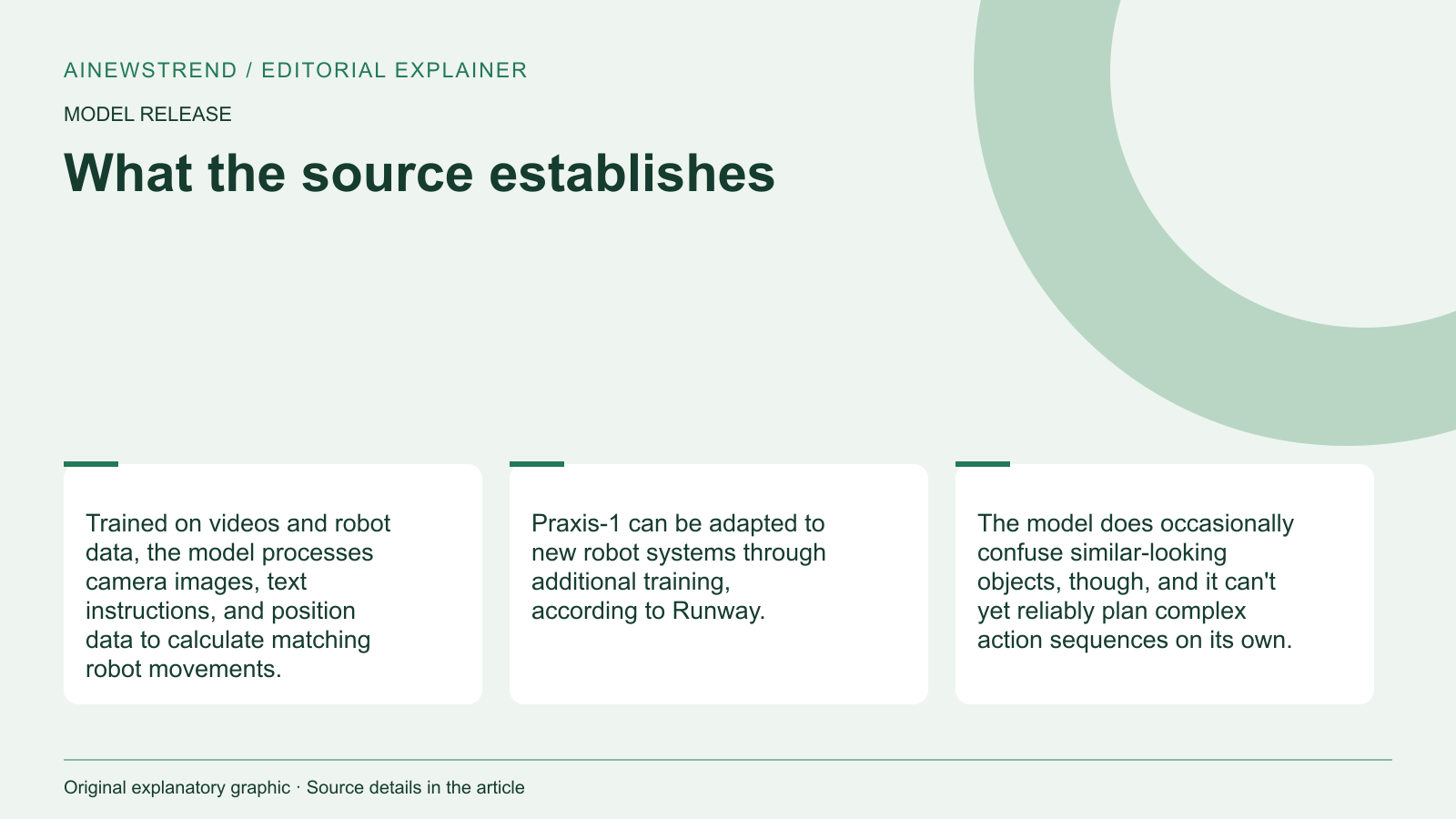
Praxis-1 takes in camera images, text instructions, and information about a robot's position. From those inputs, it predicts how the environment will change and calculates the right robot movements. As new camera frames come in, the model continuously adjusts its control. The model is built on a video model that learned how objects move and interact from ordinary footage. Runway then fine-tuned it with videos of human actions and robot data. This approach could reduce the need for expensive robot-specific datasets, which have traditionally been collected just to train these kinds of systems.
Limitations and availability
Developers can download Praxis-1 from Hugging Face after signing up and agreeing to the access terms. The code is on GitHub. According to Runway's announcement, pre-adapted versions for different robots are already available alongside the base model. The base model needs additional training before it can work with new robot systems. The standard model version needs a GPU with 80 GB of memory. A compressed version should fit on an RTX 5090 with 32 GB of VRAM based on Runway's memory estimates, though the actual peak memory usage hasn't been measured yet according to the GitHub docs. The model sometimes confuses similar-looking objects and struggles with vague instructions, according to Runway's research report. For longer tasks, individual steps need to be spelled out because Praxis-1 can't reliably plan complex action sequences on its own yet.