
What changed
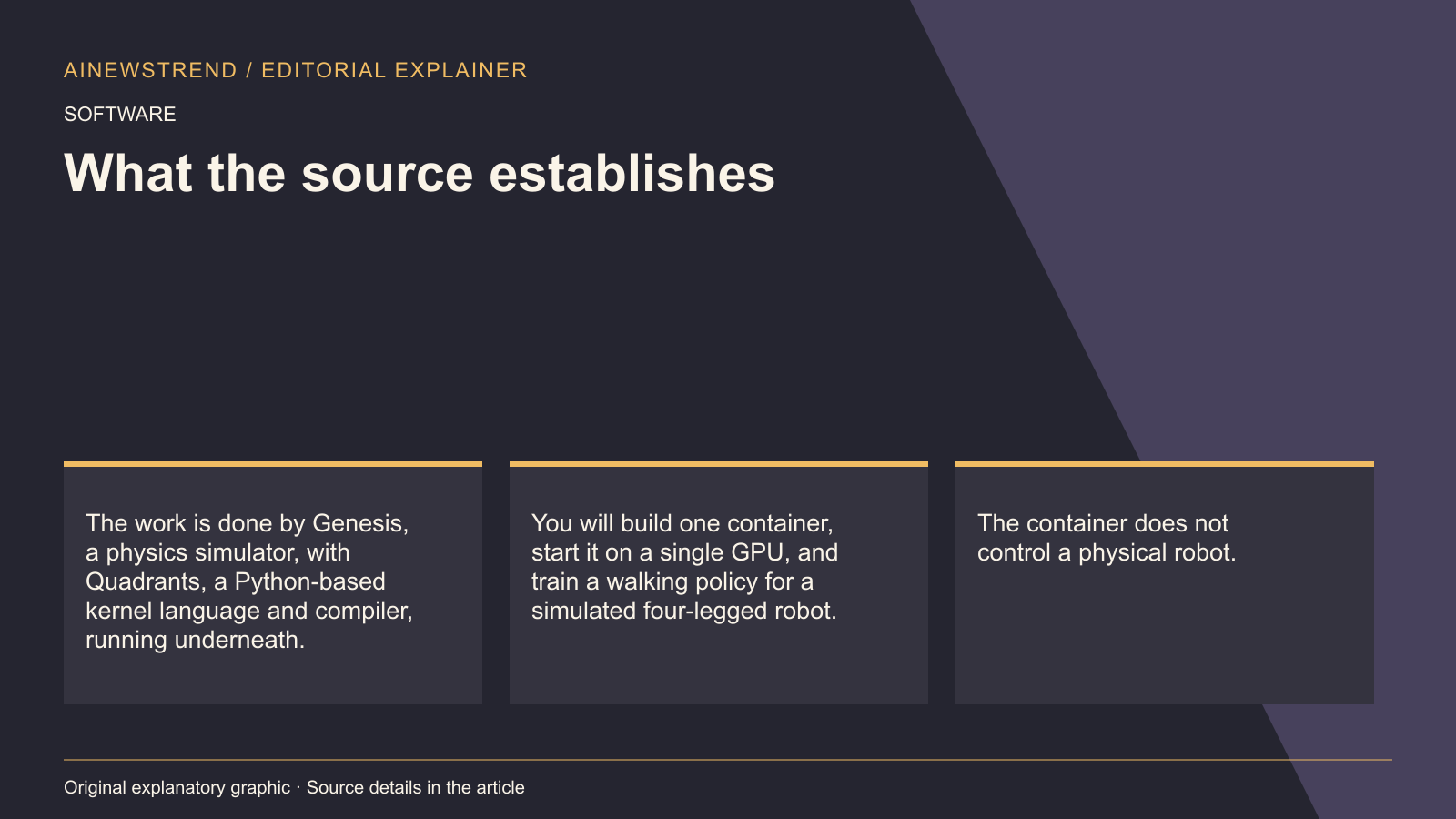
AMD has demonstrated how to train a simulated four-legged robot using ROCm 10.1 and an AMD Instinct GPU. The example uses Genesis, a physics simulator, and Quadrants, a Python-based compiler, to run the simulation entirely on the GPU. The training process involves reinforcement learning, where a simulated Unitree Go2 robot learns to walk forward at a steady 0.5 m/s. The example runs on a single GPU, with the ability to simulate up to 4096 robots at once.
What this means in practice
The demonstration shows how developers can use ROCm 10.1 to run complex physics simulations and machine learning training on AMD GPUs. The training process involves reinforcement learning, where the robot learns to walk by receiving rewards based on its movement and stability. The example uses PyTorch 2.13.0 and the PPO algorithm from the rsl-rl library. The training process runs on a single GPU, with the first iteration being slower due to the compilation of the physics code by Quadrants. Subsequent iterations run at a consistent speed of around 400,000 simulated control steps per second. The example requires an AMD Instinct GPU from the CDNA family supported by ROCm 10.1, along with Docker and sufficient disk space for the image.
Limitations and availability
The example is designed to run on an AMD Instinct GPU with ROCm 10.1. It uses a Docker image that includes all necessary components, including ROCm, PyTorch, Quadrants, and Genesis. The training process runs entirely in simulation and does not control a physical robot. The example is available through the AMD-Ecosystem/Genesis repository on GitHub, with instructions for cloning, building, and running the Docker container. The supplied announcement does not specify the exact performance metrics or benchmark comparisons for this example.