
What changed
Google announced expanded AI agent observability and evaluation capabilities across its Data Cloud, offering unified visibility into both first-party (1P) and custom third-party (3P) agents. These tools are now available in BigQuery and Looker, enabling teams to track agent behavior, costs, and data interactions.
What this means in practice
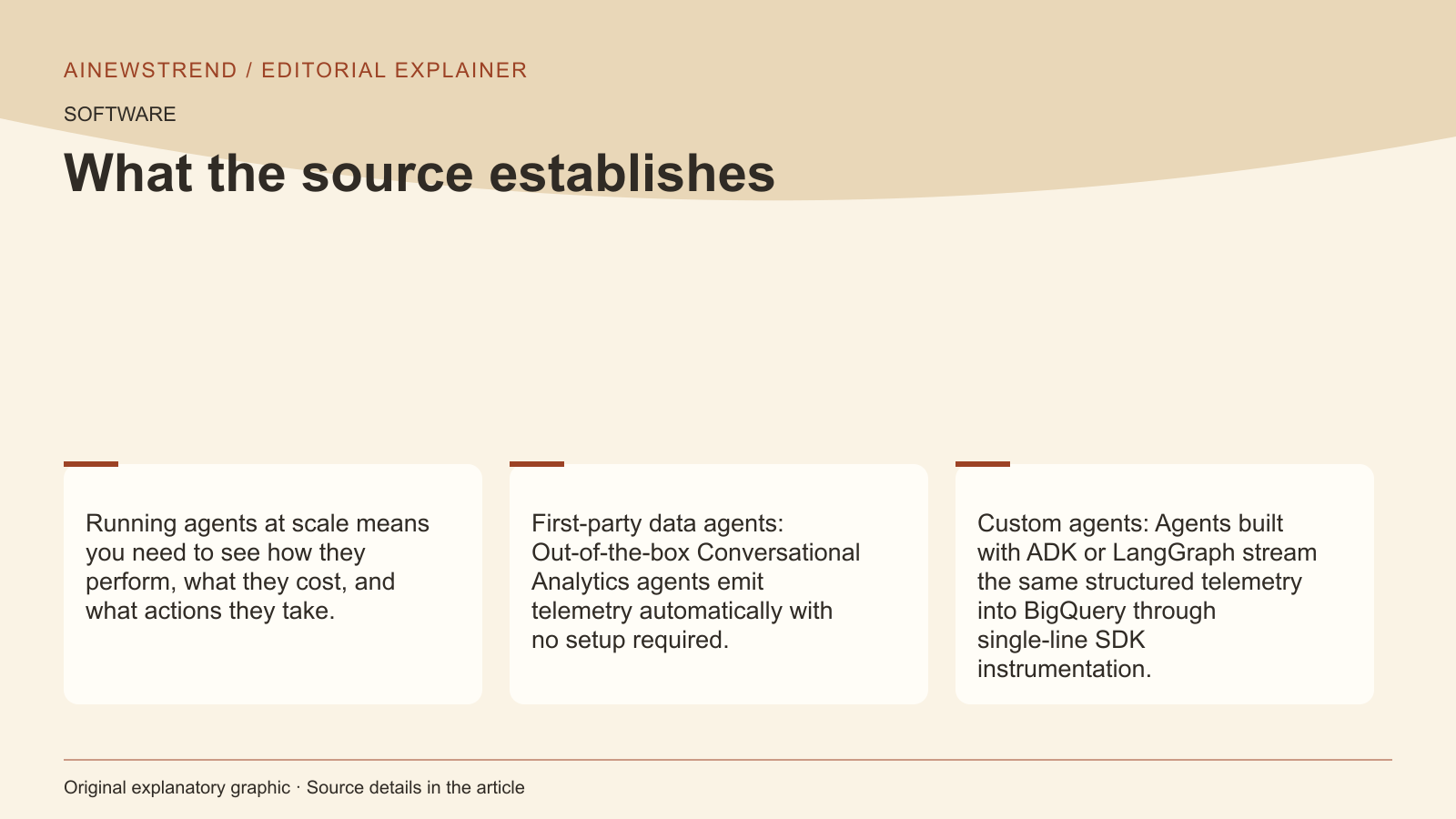
The new observability framework allows enterprises to capture telemetry from agents, landing it in BigQuery tables they own. This includes metrics like token usage, latency, and query spend, alongside conversation logs and trace data. For first-party agents, telemetry is automatically captured with no setup required, while custom agents built with frameworks like ADK or LangGraph can be instrumented with a single line of code.
In BigQuery, prebuilt dashboards help track usage, active sessions, and knowledge sources, while Looker provides dashboards for engagement and token usage. Users can also build custom reports using open-source templates or deploy ready-made Looker Blocks for real-time monitoring.
Limitations and availability
The observability features are available in Google Cloud core and Looker (original) as general availability (GA), with some dashboards in preview. Conversation logging is governed by default, with privacy guardrails that exclude sensitive data from telemetry. For deeper auditing, agents can be opted into conversation logging, which streams user prompts and responses into customer-owned BigQuery tables.
The tools are designed to help enterprises manage costs and ensure data privacy, with FinOps guardrails like query and token spend caps. Evaluation tools like Prism are also available for benchmarking agent performance before updates reach users.