
What changed
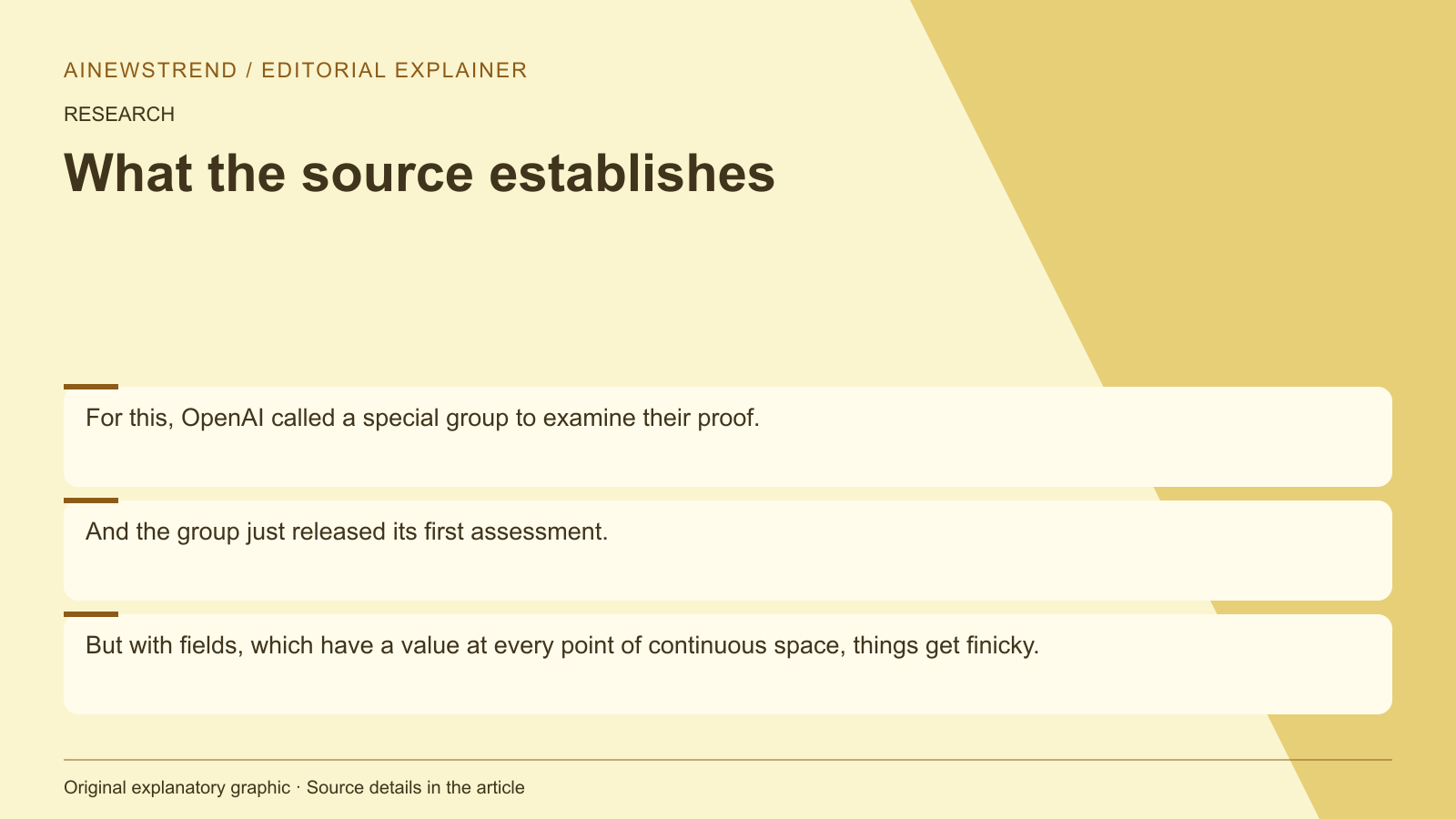
OpenAI announced progress on the Yang-Mills existence and mass gap problem, a key issue in theoretical physics. The company produced a 1147-page manuscript along with a proof verified in Lean, a programming language that checks logical steps in mathematical proofs. A special group has assessed the proof, marking a significant step in addressing this long-standing problem.
What this means in practice
The Yang-Mills problem is linked to the strong nuclear force, which holds quarks together inside protons and neutrons. OpenAI's work could help in understanding the fundamental forces of nature, potentially impacting how physicists model interactions at the quantum level. The proof's verification through Lean highlights the role of computational methods in validating complex mathematical theories. However, the assessment by the special group indicates that further scrutiny is needed to confirm the proof's relevance to the problem as defined by mathematicians and physicists.
Limitations and availability
The supplied announcement does not specify the exact details of the proof's verification or the group's assessment findings. The proof's relevance to the problem remains under evaluation, and the practical implications for particle accelerators or experimental physics are not detailed. The work represents a theoretical advancement rather than an immediately applicable solution. The availability of the proof and its verification process is through the provided manuscript and Lean code, which are accessible to the academic community.