
What changed
OpenAI's chief scientist, Jakub Pachocki, has warned that upcoming AI systems may outpace current safety checks and urged rival companies to agree on shared limits. He proposed making perplexity a standard metric for AI progress and released internal data on the GPT series, showing capabilities emerging at fixed perplexity thresholds.
What this means in practice
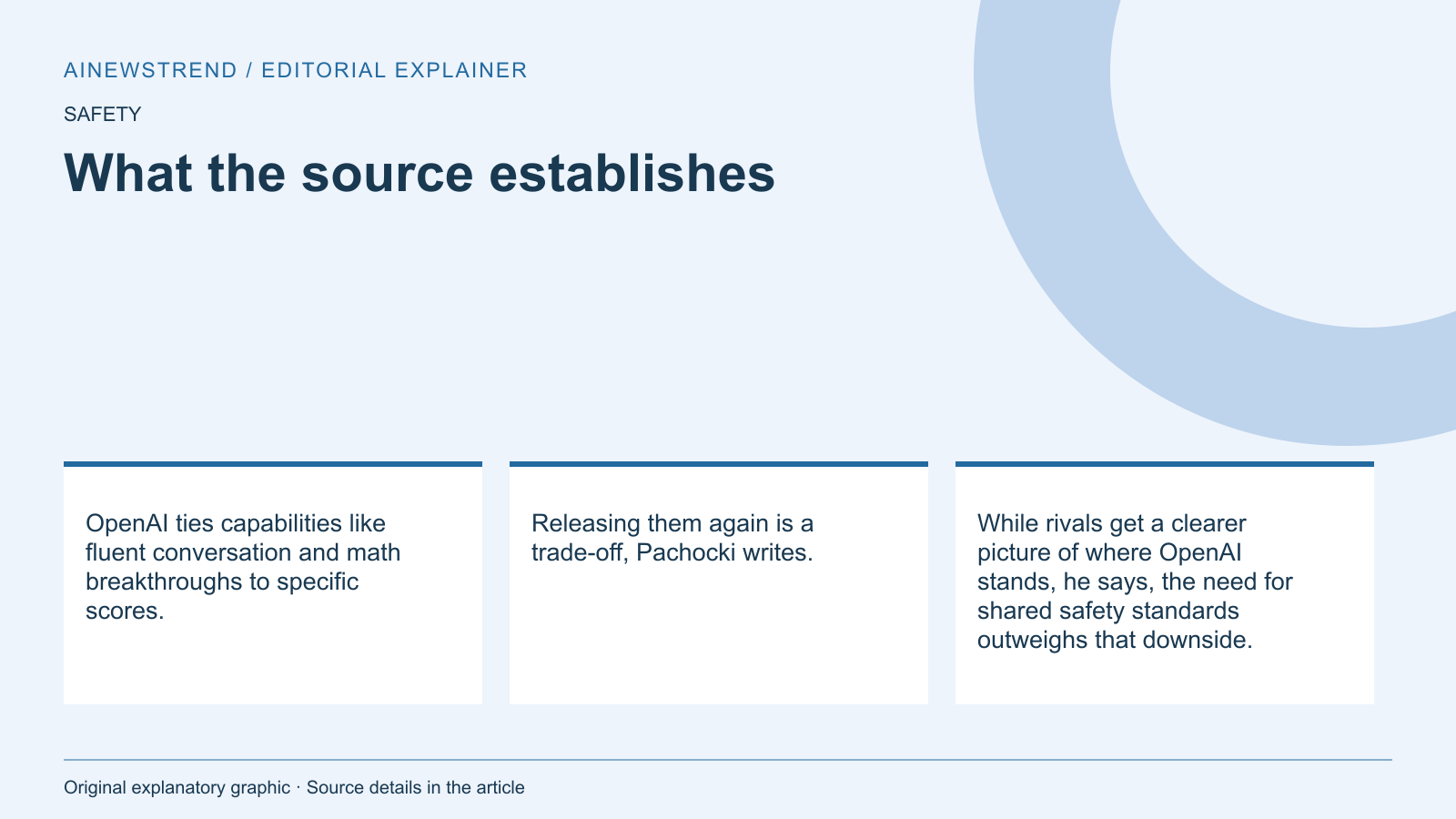
Pachocki's data indicates that specific capabilities, such as fluent conversation and logical reasoning, emerge at distinct perplexity levels. For instance, GPT-3.5 enabled fluent conversation at around 0.99 log-perplexity, while GPT-4 unlocked productive chain-of-thought reasoning at about 0.91. Transformative capabilities in cybersecurity and math emerged below 0.8. Pachocki also noted that models with lower log-perplexity scores demonstrate more capabilities, with a sharp drop in scores starting in 2026.
Limitations and availability
Pachocki acknowledges that perplexity is not a direct measure of performance on useful tasks but is valuable for predicting emergent capabilities. He warns that standard alignment auditing methods may become less effective as models improve at recognizing when they are being tested. The data released includes models up to GPT-6.2 Astra and an internal model at around 0.73 log-perplexity. The chart also notes that the sharp acceleration in scores from 2026 is largely due to long-term research and compute investments, with AI itself contributing to design work on newer models. The supplied announcement does not specify the exact timeline for future models or the exact nature of the shared safety limits.