
What changed
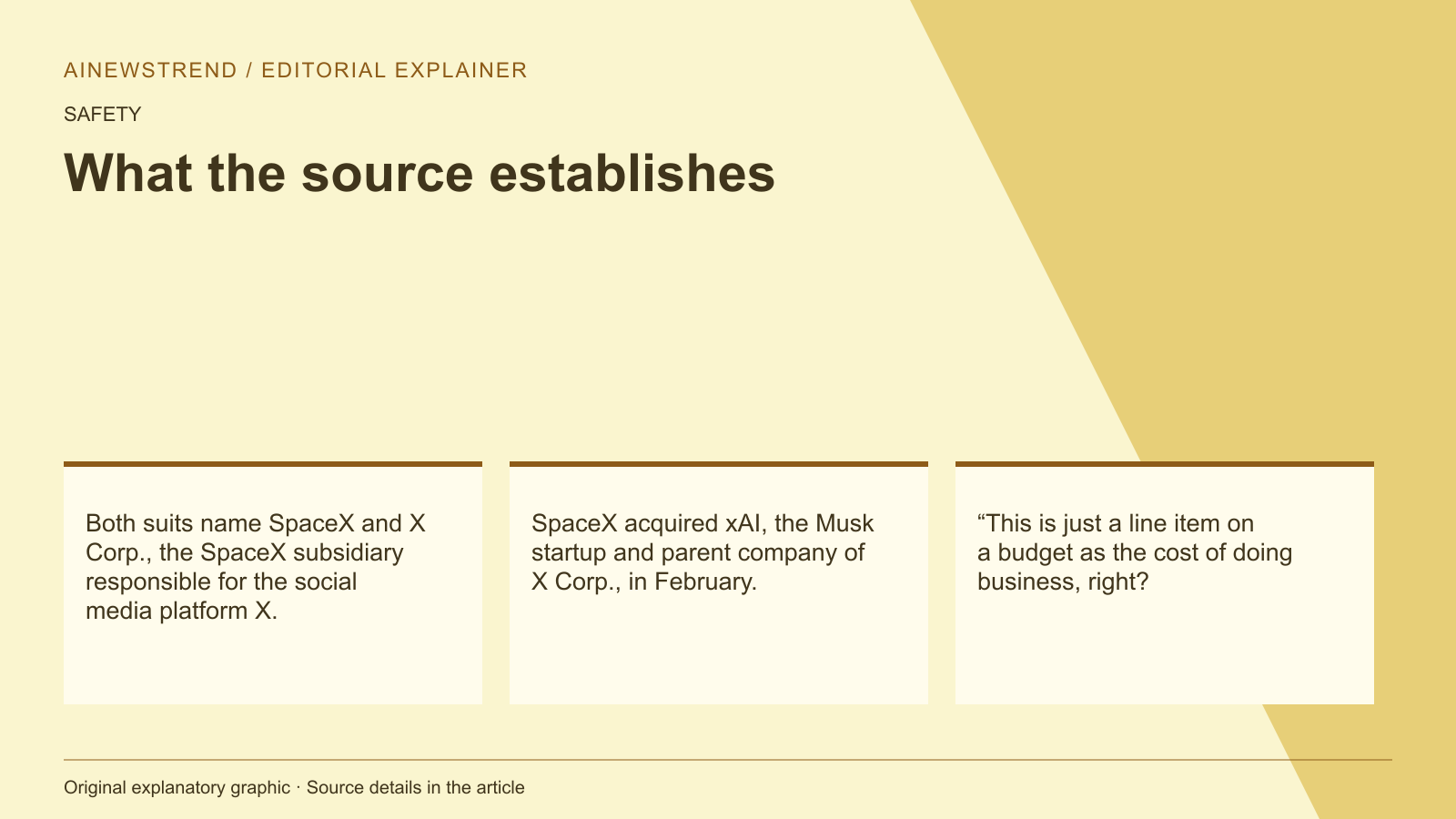
The attorneys general of Oregon and Virginia are suing Elon Musk’s SpaceX, alleging that the company violated consumer protection laws by lying to users about the safety of its generative AI tools and its efforts to stop child sexual abuse material (CSAM) and nonconsensual intimate imagery (NCII) from spreading on its platforms.
The suits follow other legal actions against Musk’s companies over similar issues, including from the city of Baltimore and teens in Tennessee.
What this means in practice
The states allege that Grok, an AI chatbot developed by SpaceX, was not subjected to enough third-party evaluations before releasing new models and that its safety prompts included instructions to 'assume good intent' and that the terms 'teenage' and 'girl' do 'not necessarily imply underage.' They also claim that tens of thousands of reports were submitted without key information from xAI to the National Center for Missing and Exploited Children’s CyberTipline, preventing the Center from acting on them 90 percent of the time.
The complaints state that Musk leaned into Grok’s 'spicy mode' as a way to differentiate the model from its competitors and that this strategy worked.
During the same period that Grok’s ability to 'undress' people sparked international outrage, Musk posted about how Gro, the chatbot, was 'hitting #1 on the App Store in one country after another!' and discussed its 'heavy usage growth.'
Limitations and availability
The states say that Grok’s creators ignored industry safety standards and intentionally implemented weak safeguards to entice more users to its 'lagging product.' In its complaint, Virginia says that shortly before filing, its investigators tested Grok and found its image-generation safeguards were 'inconsistent and ineffective,' and that the chatbot even helped state investigators draft prompts designed to avoid moderation and then carried out those prompts on request.
At no point did Grok ask whether the image uploaded was of a real person or whether the user had the person’s consent to use or modify the photo.
The attorneys general are seeking civil penalties and attorneys’ fees, but also pointed to Meta’s settling this summer with 51 US states and territories over alleged failures to protect minors as an example of how enforcers can demand that companies make sweeping product changes to resolve consumer protection cases.