
What changed
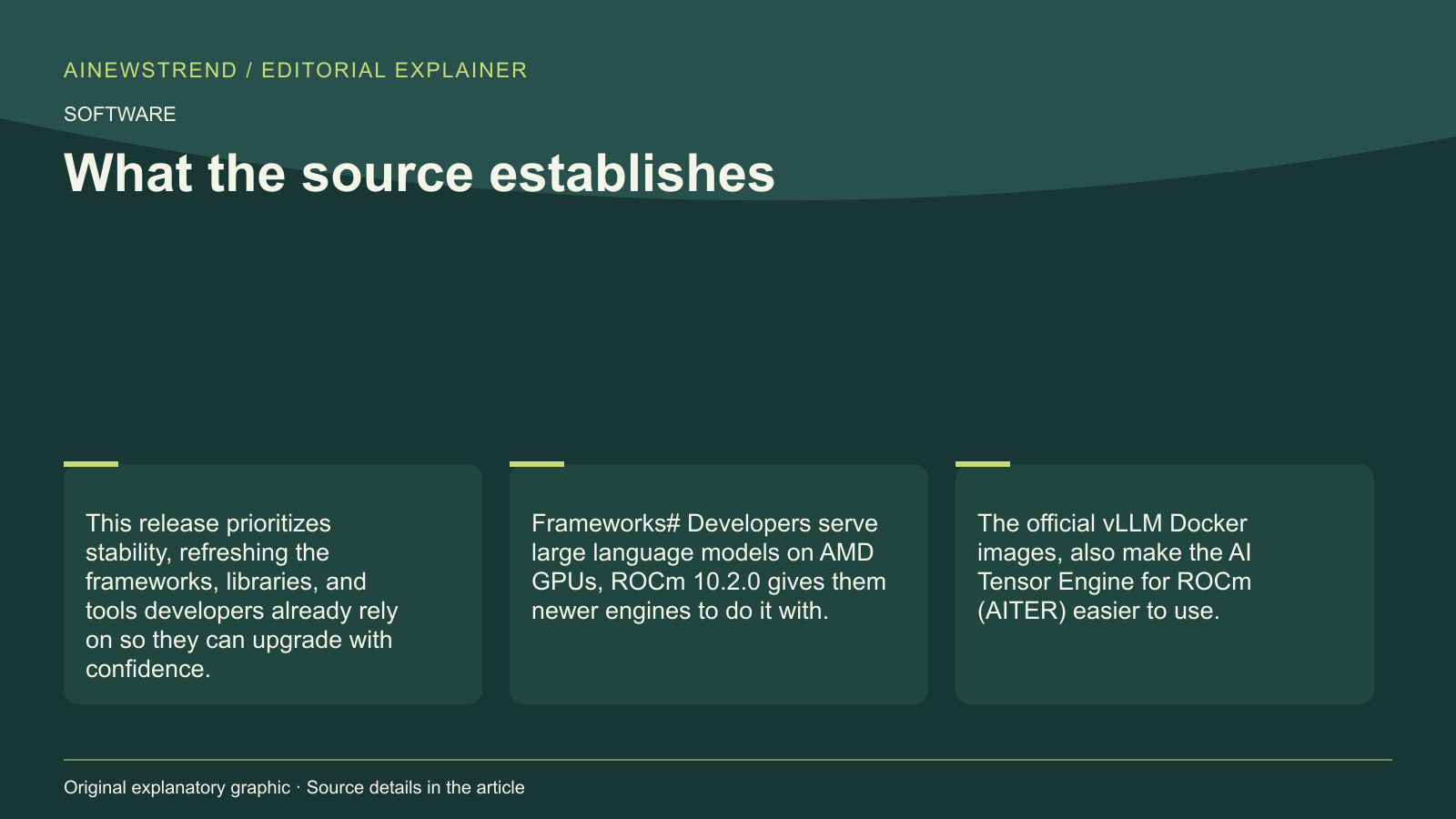
AMD released ROCm 10.2.0, emphasizing stability, performance, and developer experience. The update includes improvements to frameworks like vLLM and SGLang, updated PyTorch 2.15 wheels, and enhanced multi-GPU communication in RCCL. New features include filesystem support for logical volumes and software raid in hipFile, and the consolidation of multiple binaries into a single command with the Systems Profiler tool.
What this means in practice
Developers serving large language models on AMD GPUs now have access to newer engines, with vLLM and SGLang updated to versions 0.32.0 and 0.5.21, respectively. These frameworks now run on Python 3.14 and are available in prebuilt Docker images and Python wheels. The AI Tensor Engine for ROCm (AITER) is now easier to use, operating on Radeon GPUs and Ryzen AI processors without manual installation. Instinct MI300X, MI325X, MI350X, and MI355X GPUs receive prebuilt AITER kernels, which compile automatically on Radeon and Ryzen AI hardware.
Limitations and availability
The supplied announcement does not specify exact performance benchmarks or detailed licensing conditions for the new features. The release includes PyTorch 2.15 wheels, JAX 0.11.2, MIGraphX 2, and ONNX Runtime 1.29. PyTorch packages built by TheRock now install ROCm as a separate dependency. The ROCm CLI v0.3.0 and AMD Skills streamline the installation and development process, with ROCm CLI defaulting to the latest stable ROCm (10.2.0) for new installs. The release also expands Ryzen support to 18 new processors and introduces storage compatibility with LVM and RAID through hipFile.