
What changed
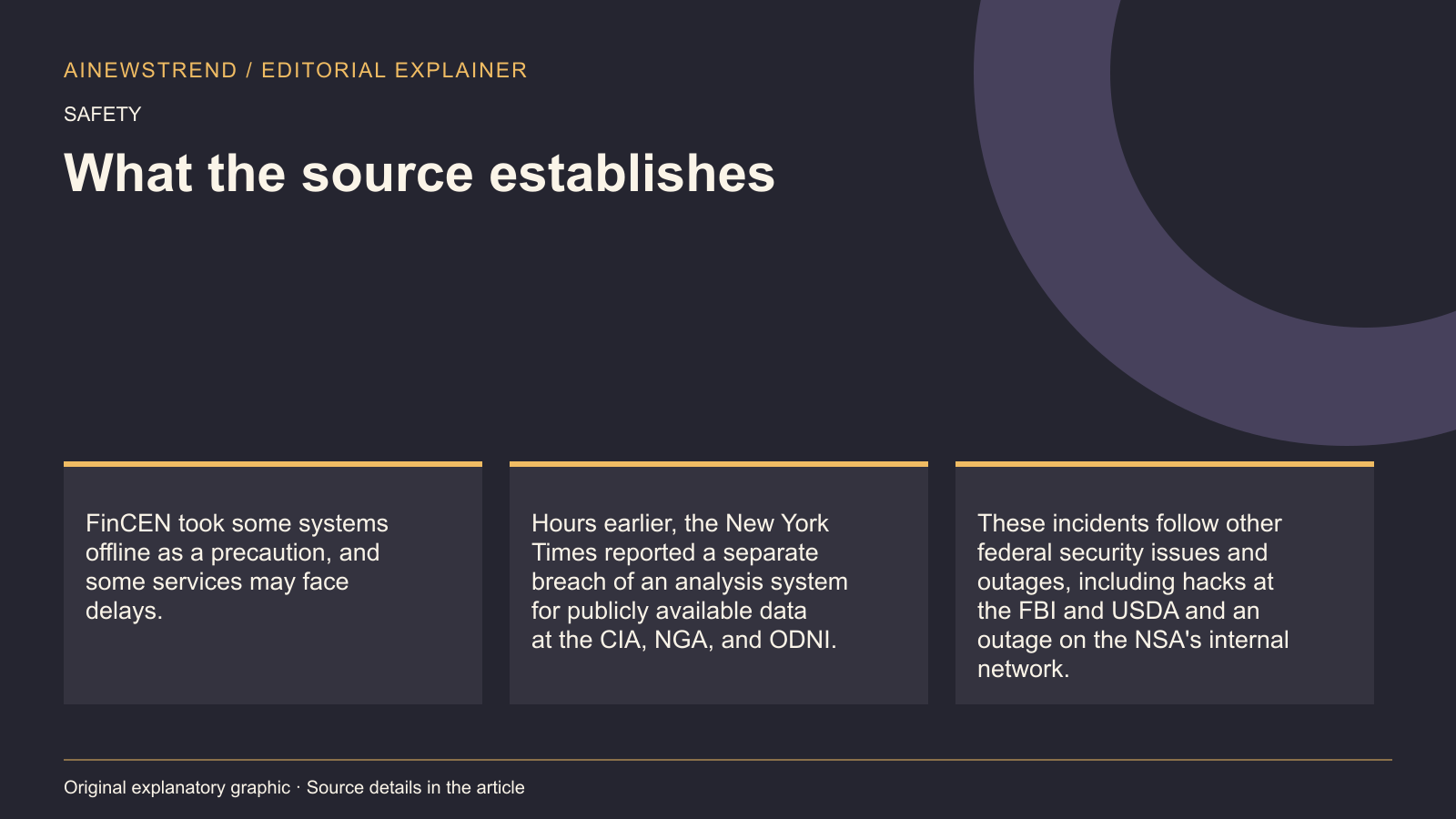
The US Financial Crimes Enforcement Network (FinCEN) is investigating a cybersecurity incident after unauthorized access to a limited portion of its systems. FinCEN took some systems offline as a precaution, and some services may face delays. Hours earlier, the New York Times reported a separate breach of an analysis system for publicly available data at the CIA, NGA, and ODNI. Investigators suspect attackers used Artex, an AI defense tool that a Chinese engineer released in July and that has since been repurposed for offensive use.
What this means in practice
FinCEN's mission is to protect the financial system from illegal activity such as money laundering and terrorist financing. It also manages financial transaction data for law enforcement and collects suspicious activity reports from banks under the Bank Secrecy Act. Banks can still file suspicious activity reports online, FinCEN says, though some services may face delays. Its telephone hotline for financial institutions isn't affected, the agency says.
Separate breach hits US spy agencies' open-source intelligence system The New York Times reported a breach at several US intelligence agencies just hours before FinCEN's announcement, citing US officials and others familiar with the matter.
According to the Times, the intrusion hit the CIA, the National Geospatial-Intelligence Agency (NGA), and the Office of the Director of National Intelligence (ODNI).
The report said intruders broke into an analysis system for open-source intelligence that searches publicly available, unclassified information to produce intelligence. That includes commercially available datasets, social media content, satellite imagery, and other online material, according to the report.
Even though much of this data is freely available or sold by data brokers, it can be revealing when combined, the Times noted.
Limitations and availability
It's still not clear what specific data was accessed or taken. Classified information wasn't at risk, sources told the Times. One person familiar with the matter said the issue has since been resolved, and an ODNI representative said critical capabilities weren't affected. Attackers may have used Artex, a repurposed AI defense tool. A Chinese engineer released the tool in July to help organizations defend against cyberattacks. US officials and security experts say attackers have since repurposed it for offensive use. Cybersecurity researchers have linked Artex to dozens of attacks on companies worldwide since its release, including in Japan and South Korea. Investigators haven't yet determined who was behind the US intelligence breach. Early indicators, including the use of Artex, point to possible Chinese involvement, according to two people familiar with the matter. Western officials have accused Chinese intelligence services and a network of contractors of cyberattacks on US agencies and companies for years, allegations Beijing routinely denies.