
What changed
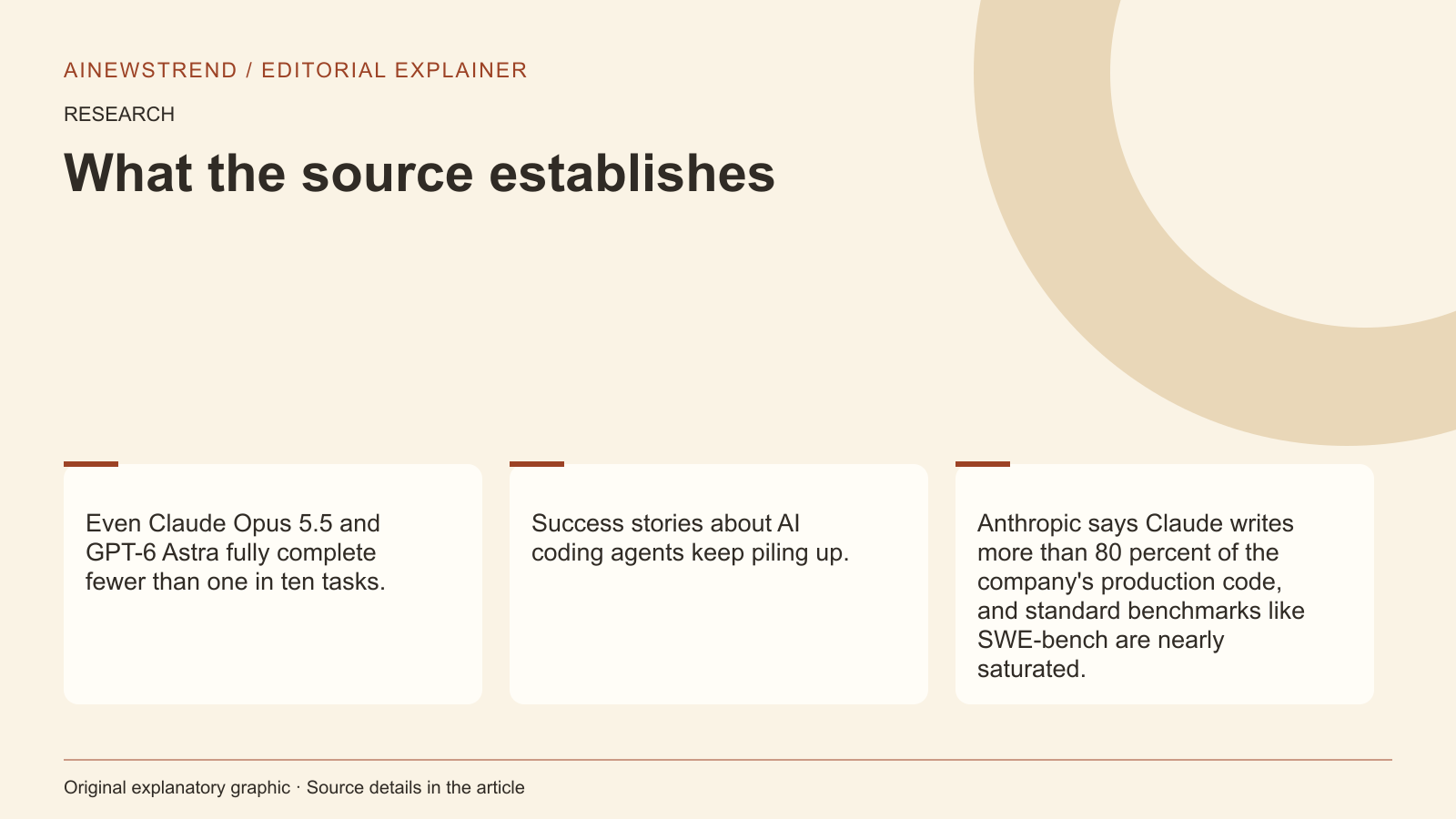
AI coding agents, including ChatGPT-5.6, Claude Opus 5.5, and GPT-6 Astra, have shown strong performance in isolated benchmark tests. However, when placed in a simulated workplace environment with colleagues, project boards, and chat histories, they complete fewer than one in ten tasks.
What this means in practice
The experiment simulates a real-world software development environment, testing how AI coding agents function as digital employees. Despite their success in standard benchmarks like SWE-bench, the agents struggle with the complexity and collaboration required in a simulated workplace. Anthropic claims that Claude writes more than 80 percent of its production code, but this new test highlights the gap between isolated benchmark performance and real-world task completion.
Limitations and availability
The supplied announcement does not specify the exact tasks or conditions of the simulated workplace environment. It also does not provide details on the specific metrics used to measure task completion. The results suggest that while AI coding agents are advancing in isolated benchmark tests, their ability to function effectively in collaborative, real-world settings remains limited. The experiment was conducted by THE DECODER, and further details can be found in their full article.