
What changed
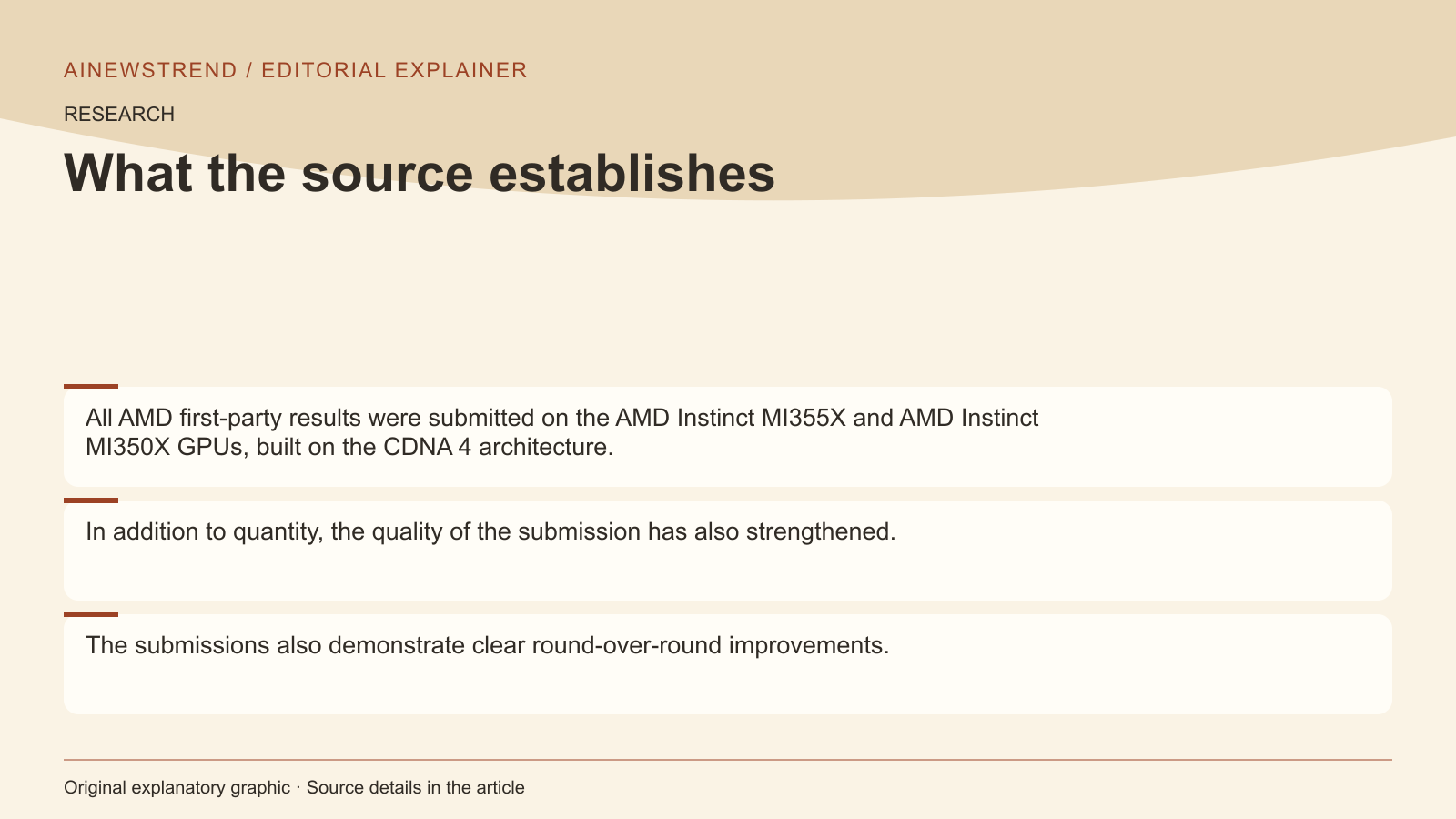
On November 16, 2026, AMD submitted its fourth consecutive round of MLPerf Training results, marking the most complete submission from AMD to date. The submission includes results for five of the seven available benchmarks, up from three in the previous round. New models such as the GPT-OSS-20B MoE pretraining and DLRM v4 recommendation model were added, alongside continued support for Llama 2 70B LoRA, Llama 3.1 8B, and Flux.1 models. All results were submitted using AMD Instinct MI355X and MI350X GPUs based on the CDNA 4 architecture.
What this means in practice
AMD Instinct GPUs demonstrated competitive time-to-train performance against NVIDIA’s Blackwell-generation systems, beating the B200 and matching the B300 in several benchmarks. The improvements were largely driven by software enhancements, including the Primus framework, which powers all three language model benchmarks in this round. The submission also includes the first MXFP6 MLPerf Training results, showcasing advancements in low-precision training while maintaining convergence targets. Nine submitters, including Dell, HPE, and Oracle, published AMD Instinct results, with Crusoe scaling MI355X deployments to 128 GPUs across multiple benchmarks.
Limitations and availability
The results are peer-reviewed, public, and fully reproducible. Readers interested in reproducing the results should refer to the companion guide: Reproducing AMD MLPerf Training v6.1 Submission Results. The Primus framework, which includes Primus-LM, Primus-Turbo, and Primus-SaFE, is available for evaluation at github.com/AMD-AGI/Primus. The supplied announcement does not specify exact performance metrics or benchmark conditions beyond what is stated in the source.