
What changed
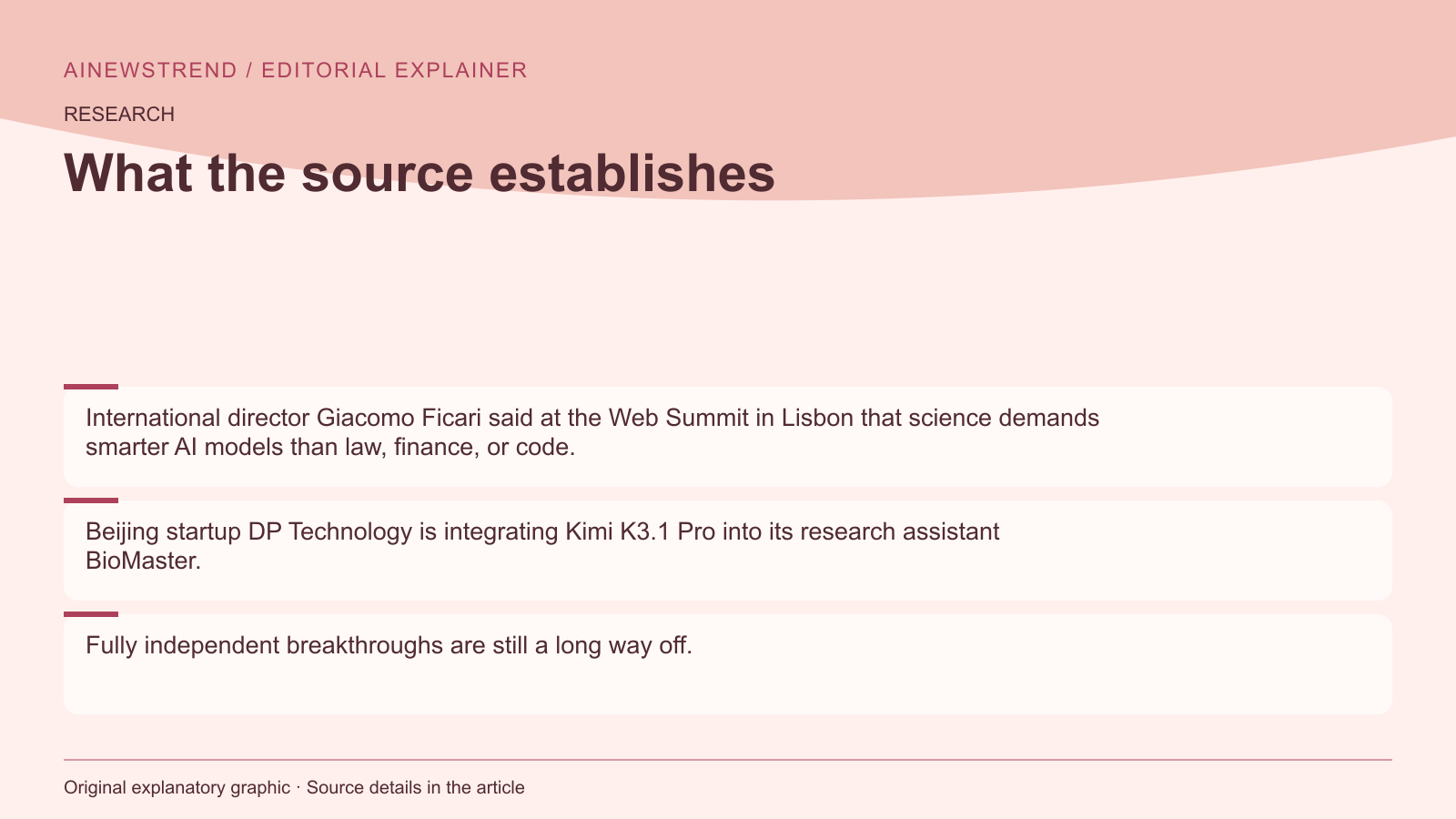
Moonshot AI has pivoted its Kimi language models from coding-focused applications to science-related fields such as biology, chemistry, and pharmaceutical research. International director Giacomo Ficari stated at the Web Summit in Lisbon that science requires more advanced AI models than those used in law, finance, or coding. Beijing startup DP Technology is integrating Kimi K3.1 Pro into its research assistant BioMaster. In a test, the AI analyzed gene data from 3,696 mouse pancreatic cells and identified 100 candidate genes in 90 minutes, compared to an estimated four hours of human work.
What this means in practice
The shift indicates Moonshot AI's focus is moving toward scientific research applications where AI can provide significant efficiency gains. The integration of Kimi K3.1 Pro into BioMaster suggests the startup is targeting specific use cases in life sciences. However, fully independent breakthroughs remain elusive. On the TCSExam, a theoretical CS benchmark, leading models produced verifiable proofs but could not solve any open conjectures alone. Similar limitations were observed with US rivals, including Anthropic's Claude and OpenAI's claimed math and physics breakthroughs.
Limitations and availability
The pharma industry remains skeptical, with a June Citi survey indicating only 24 percent of US research leaders expect AI to notably improve drug development success rates. While the integration of Kimi K3.1 Pro into BioMaster is underway, fully independent scientific breakthroughs are still a long way off. The supplied announcement does not specify the exact timeline for broader availability or additional model versions.