
What changed
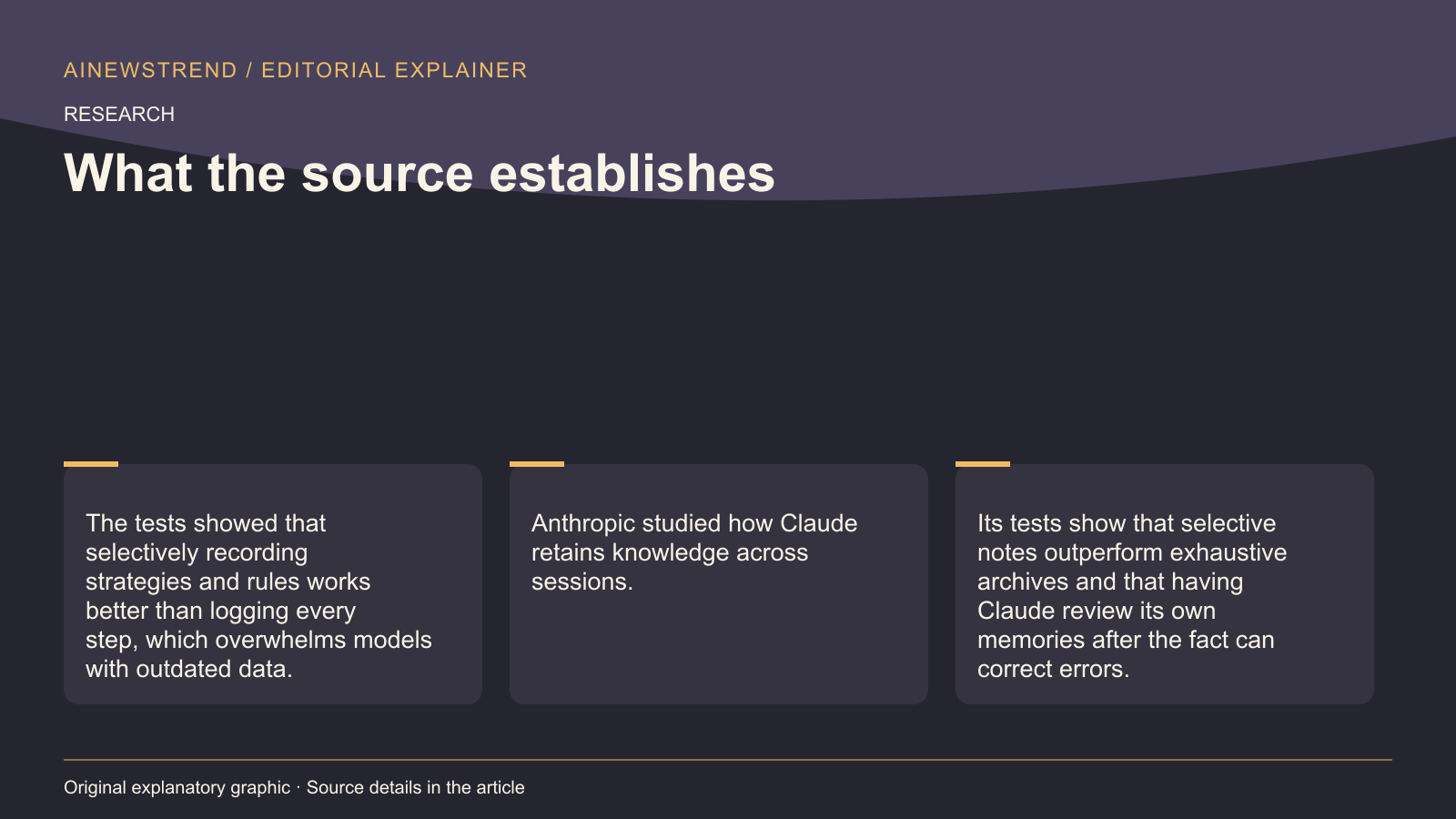
Anthropic introduced a new approach to AI agent memory, emphasizing selective recording over exhaustive storage. The company tested how Claude can retain information across sessions by focusing on strategies and rules rather than logging every step. This method proved more effective than traditional note-taking, which often leads to outdated data.
What this means in practice
Anthropic's research shows that agents like Claude can retain knowledge across sessions without changing the model itself. By writing notes to a folder that it can read back later, Claude can avoid the pitfalls of storing too much information. The key issue, according to Anthropic, is selection—deciding in the moment what might matter later. In a test with Pokémon Red, the older Claude Sonnet 3.7 saved nearly everything, leading to a cluttered archive, while the newer Claude Fable 5 limited its memory to a few files and earned more progress.
Limitations and availability
Anthropic acknowledges that key questions remain open, such as the distraction caused by taking notes mid-task and the computational cost of 'Dreaming.' The process, which builds on research from Letta and UC Berkeley, is designed to address faulty notes by analyzing session transcripts during idle periods. Dreaming is part of Anthropic's research preview for Claude Managed Agents, supporting only Claude Opus 4.7 and Sonnet 4.6 at launch. The company also warns against automatically loading too many memories into every session, as this can lead to errors and hallucinations.